Thursday, January 2, 2025

SCENES FROM FREDDY’S LIFE: AN AMERICAN TRAGEDY: THE GIRL FROM RIVERSIDE

BETWEEN TWO WORLDS
FADE IN:
EXT. CONCRETE TABLE ACROSS THE STREET FROM GREEN RIVER MALL - AFTERNOON
AERIAL EXTREME LONG SHOT FOCUSES IN ON  A SMALL FIGURE SITTING AT A CONCRETE TABLE, WRITING, A RIVER ON ONE SIDE AND THE MALL ON THE OTHER SIDE.

FREDDY LOUCHE is sitting at a concrete table across the street from GREEN RIVER MALL, a huge sprawling complex. Behind him flows GREEN RIVER, which is concealed by the brush that runs along it. He is writing in a notebook. 

FREDDY (V.O.)
I’m sitting at a concrete table on a strip of lawn that separates Green River
Palace from riverside, the two Americas. The one passes its time at the mall;
the other living outdoors because there ain’t nowhere else to live. I live in the
middle with my dad. I don’t know anyone from the mall world, and only one
person from riverside. I’ve brought my notebook to write some shit, this shit,
but I’m here mostly hoping that July might appear to me, because that’s what
she’s done before, just suddenly appear. But now, right now, I really need to
talk to her, but I ain’t sure she’s coming because I haven’t seen her in a while.
The first time I met July, in fact each of the three times she appeared to me, I
was at this table, smoking a cigarette thinking about just shit, you know.

FLASHBACK
EXT. SAME CONCRETE TABLE ACROSS FROM GREEN RIVER MALL - AFTERNOON
JULY appears out from the bushes along the river and approaches Freddy from behind. She’s dressed like a boy, Levis, a blue hoodie with the hood over her head like she’s hiding and cheapo tennis shoes. Her clothes are shabby but clean.

JULY
Hey.
(Freddy looking around, jumpy, nervous.)

FREDDY
Who are you?

JULY
July.

FREDDY
July? That’s this month.

JULY
Yeah, but it’s also my name.

FREDDY
That’s weird. To be named after a month.

JULY
I was born on the 4th of July. My mother thought the name would bring me luck.

FREDDY
Guess it’s good you weren’t born in October or February, huh?

JULY
Is that a joke?

FREDDY
Nah, I was just thinking it’s weird is all. Are you one of those fucking riverside
people?

JULY
Yeah, I guess I am one of those fucking riverside people, but don’t you think
riverside people makes us sound pretty freaky?

FREDDY
Well it is, ain’t it?

JULY
Yeah, kinda but we ain’t a bunch of freaks.

FREDDY
I didn’t mean that just... Fuck I don’t know what I meant. I guess your name
didn’t bring you much luck.

JULY
That’s one way of looking at it.

FREDDY
I don’t see any other way to look at it. I mean you living riverside and all.

JULY
Whatever. How about a cigarette?

FREDDY
Sure.
Freddy gives her a cigarette and his red Bic lighter. July lights up as if she been smoking since she was twelve, hands cupped around the lighter. Freddy watches her closely, sensitively. Close up of July’s face. Her face is tanned from being in the sun, even reddish. Her eyes are dark brown, alert but sensitive. She watches Freddy as he watches her. It is the look of a wild animal, cautiously alert. It’s as if July’s contact with Freddy is for her brief contact with a young person like herself but one living in the normal world.

JULY
Camel regulars. Pretty potent smoke!

FREDDY
Yeah, a gift from a friend. Actually, I don’t smoke that much, mostly with my friends
or when I come here and think about shit. You’re pretty clean and all for livin
riverside.

JULY
Hmm.

CLOSE-UP of July’s face then of Freddy’s. She stares intently at Freddy while she lights up, as if trying to figure him out. Camera then focuses on JULY’S HANDS which Freddy admires because they aren’t pale and soft but suntanned, youthful but also womanly.

FREDDY
Do you actually live down there?

JULY
Yeah, I do. Is that so weird?

FREDDY
Well yeah it’s weird. I mean don’t you think so?

JULY
Maybe it is, but lots of people are livin that life. Maybe it’s more sad than weird. You
ever thought of that?

FREDDY
Not really.

JULY
It don’t matter. I’ve gotten used to it.

FREDDY
So what did you do, run away?

JULY
No, my mom’s boyfriend left one day. We were staying at a motel and my mom
wanted to take me to the beach because I’d never seen the ocean before.

FLASHBACK AS TOLD BY JULY
INT. SHABBY MOTEL

JULY’S MOTHER
Come on, Clayton, don’t be an asshole. Let me take the Firebird to the beach. July’s
never seen the ocean.

CLAYTON
No bitch’s gonna drive my Firebird.

JULY’S FLASHBACK CONTINUED
INT. CITY BUS - AFTERNOON
July’s mom looks pissed. July looks out the window, has a dreamy somewhat melancholy expression. The camera shifts from her face to the animated beach town scenery, palm trees, blue sky, exotic but not posh, more like a surfing community. Then the ocean appears with a sprinkling of sun bathers and swimmers. The sky is blue with just a scattering of white clouds.

JULY’S FLASHBACK CONTINUED
EXT. PARKING LOT OF THE MOTEL
July and her mother get off the bus. Clayton’s Firebird is not in the parking lot.

JULY
Doesn’t look like Clayton here.

JULY’S MOTHER (Stern look.)
He’s such an asshole. Out at some bar but can’t even drive us to the beach.

JULY’S FLASHBACK CONTINUED
INT. MOTEL ROOM
July and her mother enter the hotel room. Pieces of luggage and plastic bags full of stuff are on the floor but Clayton’s stuff is gone.

JULY
(It’s clear that Clayton has left.)
Clayton’s stuff isn’t here, Mom. Did he leave?

JULY’S MOM
That fucking asshole left us.

BACK TO FREDDY’S FLASHBACK
EXT. CONCRETE TABLE ACROSS THE STREET FROM GREEN RIVER MALL – AFTERNOON

JULY
That’s how we ended up on the streets.

FREDDY
Bummer. Clayton sounds like a real cool guy.

JULY (Pensive.)
I knew he was an asshole when Mom brought him home. The Firebird should have
tipped her off. Only macho rednecks drive that kind of car, but those were the only
kind of guys Mom hung out with. I always hoped she’d come home with some nice
guy, you know a guy that drives a VW bus or a Datsun like the one Chris McCandless
drove, but she never did.

FREDDY
McCandless who?

JULY
The guy in the story Into the Wild. I guess you don’t read much do you?

FREDDY
You guessed right. So was this guy McCandless a nice guy?

JULY
A lot nicer than Clayton.

FREDDY
What about your dad?

JULY
What about him? You’d have to ask my mother.

FREDDY
Didn’t you?”

JULY
Of course I did, dufus. Whaddayathink?

FREDDY
I don’t know. Don’t get all upset. We’re just havin a conversation.

JULY
Yeah. Sorry. I’ve been on edge for a while.

FREDDY
It’s understandable. I mean it can’t be easy livin the way you do.
(Behind her upfront anger and toughness July is still a girl—maybe even a little scared.)

JULY
It wasn’t all that easy before. My dad wasn’t around long enough for my mother to get
to know him. I don’t think she knows which of the guys she was fucking at the time is
my father, but it don’t matter.

FREDDY
So how long you been here?

JULY
Bout a year.

FREDDY
Livin riverside for year. Shit!

JULY
No, at first it was on the streets, in a shelter a few days, in a motel a week or two, you
know, wherever.

FREDDY
How did you get money?
(July takes a long drag off her cigarette and puts it out on the concrete table leaving a black smear.)

JULY
We just got by. Can I have another cigarette?

FREDDY
 Sure.
(Freddy takes one out of the pack and lights up. Then he places the pack and the Bic in front of July.)

FREDDY
You can keep them.
(July gives Freddy a suspicious look, then accept the gift.) 

JULY
Okay, thanks.

FREDDY
No problem. Like I said, I ain’t a big smoker. Hey would it piss you off if I asked you
how old you are?

JULY
I think you just did.

FREDDY
Yeah, I guess I did.

JULY
Sixteen.

FREDDY
Fuck, were about the same age.

JULY
That means I’m older than you, right, because you can’t be seventeen.

FREDDY
I guess it does, but I bet not by much. So, how does your mom handle... you know
livin riverside? There’s got to be some really creepy people down there. I’ve seen 
some here that were really nutty, scary like.    

JULY
Damaged goods is what they are, Freddy. That’s what one of them told me once.
Homeless people are like merchandise that falls off a truck and gets broken and once
people see that it’s broken they just leave it because it’s broken. Worthless. Some are
more broken than others. Just the way it is.
(Freddy doesn’t respond, stares at July, enthralled.)

JULY
Are you still with me?

FREDDY
Yeah. I was just thinking.
 
JULY
About what?

FREDDY
Just stuff.

JULY
Like me?

FREDDY
Maybe, a little. Is that bad?

JULY
Depends on what you were thinking.

FREDDY
I wasn’t thinking nothing nasty. I don’t really think that kind of shit.

JULY
You’re a guy. All guys think nasty shit.

FREDDY
You’re entitled to think whatever you want.

JULY
What’s your name? So I don’t have to remember you as Camel boy.

FREDDY
Freddy.

JULY
You’re a strange one, Freddy. You were looking right at me but it was like you didn’t
see me. Do you drift a lot?

FREDDY
No. Why, you think it might be a disease?

JULY (July laughs.)
Maybe but probably not a fatal... Hey, I should go. Thanks for the cigarettes and
the lighter.

FREDDY
But I was goin to ask you about your mother.

JULY
Next time, Freddy. I gotta go. I'll see you around.

FREDDY
You think so?

JULY
Sure, I’ve seen you here before. I came over today because I decided you look okay.

FREDDY
Whadaya mean okay?

JULY
You’re okay. That’s all.
(July walks away toward the river, turns and waves, then disappears into the high grass and brush.)

The CAMERA PULLS UP AND AWAY leaving Freddy at the table, until he almost disappears.
BACK TO THE PRESENT

FREDDY (V.O.)
In my bones I know July ain’t gonna come back, because I’m feeling somethin’s happened
to her, but I keep coming and sit at the very same table hoping she just might show up.
Freddy opens his notebook. The pages are blank.

FREDDY (V.O.)
You’re probably wonderin what’s with the notebook. Well, you see I got into some
serious trouble last year and the police shrink told me to write down all the shit that 
happened before. When I asked her where I should begin she said begin where things 
started to go wrong. Problem is things started goin wrong in Iowa when my mother
started fucking her boss, so I figure I’ll start a year ago...4th of July because I
remember getting jumped that day. It seems July wasn’t a lucky month for me or July.


Monday, December 23, 2024

An American Story: Three Scrooges and a Good Samaritan

Once upon a time Rich Doubter stood up to a believer who claimed that he knew Jesus. Rich Doubter asked, “You say you know Jesus, but I don’t believe you. Why should I?”

Believer took a Bible from his pocket. He held up the Bible and said, “Here’s why?” Thinking to mock Believer, Rich Doubter asked, “Since you know Jesus, tell me what I must do to inherit eternal life.”

Believer answered, “Love your neighbor as yourself. Love them with all your heart and with all your soul. But love is not enough. With all your strength and with all your mind you must protect people from evil men who seek to harm them just as Jesus protected women from evil men who would harm them.”

“And if I do that I shall inherit eternal life?”

“What I know is that if you do nothing, you will have lived a worthless life unworthy of inheriting eternal life. You will die a rich man but spiritually poor. To others you will be nothing. The worth of your life will be less worth less than a piece of trash blown in the wind.”

“At least if I do nothing I will not be evil.”

“There are two kinds of evil—lesser and greater. The person who does evil commits the greater evil and becomes evil. The person who does nothing to prevent evil when he could do something commits the lesser evil. He may be less evil than the evildoer, but he is also less good as a person, perhaps not good at all. His evil is selfishness and may also be cowardliness. Such a man is worthless, unworthy of any kind of life much less eternal life. His only value is to himself; thus he is worthless to everyone else. He is worthless even to himself though he may think otherwise.”

“And Jesus told you this?”

“He showed me by living the life of a good man. Can you tell me who in the Bible betrayed goodness only to become a rich?”

“Judas?”

“You have answered correctly. Tell me, is that the kind of life you would want to live even if there is no eternal life?”

“Of course not.”

“Judas was unworthy of eternal life, but perhaps there is no such thing, just words. But tell me this. If there is no eternal life, then is Jesus nothing, just a man who once lived and died because there were no good men brave enough to save him?”

“No. He’s not nothing.”

“Why do you say that?”

“Because he helped others. He died because he was trying to help others to live spiritual lives.”

“I'm thinking Rich Doubter that you know something of the Bible. So can you tell me how does the poor man Jesus compare to the rich man Solomon? Solomon had riches and women beyond counting and Jesus was a poor man who loved women but only sought to protect them not to use them as Solomon did.”

“Compared to the good works of Jesus, Solomon’s wealth and all his wives and concubines add up to nothing truly good.”

“But the Bible says King Solomon was not only rich but wiser than any other king in the world.”

“Perhaps kings were not so wise when compared to real wisdom. Solomon threatened to cut a baby in half to reveal the real mother. That was a clever stunt but doesn’t make him wise. What would he have done if both mothers agreed? In those days, when kings gave their word they were bound by it as when Herod said to the girl Salome, ‘Ask me for anything you like and I will give it to you.’ Salome asked her mother Queen Herodias for advice, and she said, ‘Ask for the head of John the Baptist,’ whom she hated. Herod actually liked John the Baptist and didn’t want him killed, but he had to keep to his word. Emerson said, ‘Foolish consistencies are the hobgoblin of little minds,’ so maybe kings aren't all that wise. 

“I think that had Solomon been wealthy and wise he would have told the two women that one can keep the baby and the other will be given a free house and a stipend to live on so she won’t have to continue being a prostitute. I think the jealous prostitute would have gone for the house and stipend, and the nonsense of cutting the baby in half could have been avoided. And then he could have done the same for the baby’s real mother. That way the problem could have been solved with everyone being happy. But Solomon was too in love with his wealth to see that option. And he would still be evil for collecting women as sex toys, and though he was filthy rich we hear nothing about him helping the poor as Jesus did. He was like the rich men running the country today, though unlike them at least Solomon thought poor people were virtuous and not to be laughed at. But like our president he knew nothing about what it's like to be poor. If Solomon had been virtuous he would have helped the poor rather than praise them. But like the rich men running America he didn't care enough about the poor to help them.”

“For a rich man you are pretty wise yourself. So tell me which of parables of Jesus best reflects Jesus’s values.”

“It would have to be the parable of the Good Samaritan, which is about helping others in need.”

“And when asked who these others are, what does Jesus say?”

“Our neighbors, I believe.”

“You have answered correctly.”

“And then Jesus tells the story of the Good Samaritan. Yet, who was a Samaritan?”

“Yes, that was a long time ago, so perhaps we should update the story with people we do know.”

“Let’s do. That sounds interesting.”

“Then let’s begin. A Ukrainian family, a man and wife and three children, were going to the beautiful city Kyiv to shop for the week and enjoy the beauties of the city when they were attacked by Orc robbers from Russia. Today Orcs are everywhere in Ukraine. These men are malevolent brutes who prey upon innocent families, even destroying their homes and cities. They raped and killed the wife and kidnapped the children. They left the man alive to suffer as Job suffered, but stripped him of his clothes, beat him then went away with his children.”

“The poor man. He must have suffered greatly.”

“Of course he did, but the attack did not go unnoticed. It was observed by three men. The three men were Money Man, Gadget Man, and Soldier Boy. Money Man loved money above all else. Gadget Man loved his gadgets. And Soldier Boy loved being a big celebrity.”

“Why didn’t they help the family? Were they scared?”

“Together they could have defeated the brutish stupid Orc. Hearing the cries of the children and their mother, the men asked one another what they should do.” 

“And what did they say?”

“Well, Money Man was wearing very expensive clothes. His shoes alone were worth a thousand dollars. So he said, ‘I advise we do nothing because I may get my clothes soiled. I certainly don’t want to get any blood on my Casino Royale dress shirt. And the Orcs are very dangerous and may mess up my hair which is very delicate. Besides, I’ve been on the phone with the president of the Orcs and I think I can work a deal with him if we don’t do anything to anger him. So let’s just watch and do nothing for now.’”

“What about Gadget man?”

“Gadget man made missiles and satellites that could have been used against the attackers. But he too had been on the phone with the president of the Orcs and was hoping to sell him missiles and satellites. So he said, ‘I agree with Money Man. I say let’s do nothing and later make a deal with the president of the Orcs that will make us all even richer than we already are.’”

“And what about Soldier Boy?”

“Money Man and Gadget Man asked Soldier Boy if the three of them should save the family. Soldier Boy said, ‘I gotta be honest with you, I don't really care what happens to the family whether they live or die.’”

"'But you were a soldier,' said Gadget Man."

"'To tell he truth I was never into combat, and see no reason to get involved now.'"

“He just didn’t care. That’s a strange response from a soldier.”

“Well the Orcs are real soldiers who don’t care if families live or die. Maybe he wasn't a real soldier in heart and mind but just liked the uniform. It is a really cool uniform.”

“So what happened?”

“The Orcs raped and killed the wife, took the kids, one a daughter poor girl, and left the father in the road half dead.”

“Okay, so what happened next? Where is the Good Samaritan?”

“He's coming, but first let’s look at what the three men did. Money Man didn’t want to be bothered with the man, ‘I don’t want to touch him. He’s filthy, and he’s a nobody so why should I dirty my clothes and car getting him to a hospital?’

“‘Good point said Gadget Man. Besides if we help him we might spoil the deal with the president of the Orcs.’

“‘That’s right on the money,’ said Money Man. So then they asked Soldier Boy what he thought they should do.”

“‘He’s half dead so let him die is what I say. Besides, his wife is dead and dead people give me the willies and I get real squeamish at the sight of blood. So I say, let’s take off and go to a fancy restaurant where we can forget about all this shit.’ Gadget Man agreed saying that they should head for his yacht and take a holiday. Money Man said, ‘I’m up for two Big Macs, a couple Fillet-o-Fish sandwiches, a large fry and a diet Coke. Whaddya think?’ Soldier Boy said, ‘Whatever floats your boat, Money Man’ and Gadget Man nodded and smiled in agreement.”

“Was that the end of the story?”

“No. Then came along a grizzly old guy who looked like a beggar. He started going through the pockets of the dead man."

"'Who in the fuck is that,' asked Soldier Boy."

"'That's Steve Wannabe. I knew him ages ago.'" 

"'Who is he?'"

"'A political bone picker in the old day, a political scavenger. Boy he's really hit bottom having become scavenger of the dead.'"

"Then approached Old Man with his donkey. He started hitting Steve Wannabe with his cane. Wannabe tried to defend himself but Old Man was in a frenzy so Wannabe scampered away."

"Is Old Man the Good Samaritan?"

"So he is. He walked to where the injured man was lying in the road. When he saw him, he took pity on him. Though very old and could barely walk himself, Old Man went to him and bandaged the man’s wounds by tearing off the sleeves of his own shirt. He saw the dead woman and began to weep. ‘You poor, poor man. Your wife is dead. Where are your children?’

“‘The Orcs killed her and took the children.’

“‘Yes, they are evil monsters hardly human. I was once the president of a rich country but no longer. I'm not sure my people will help yours to fight the Orcs since three selfish men have taken control of my country and they will help no one because they worship only money and themselves and care nothing about other people, not even their own. They say they worship God, but they do so in front of a mirror. Jesus didn't worship God but believed God had called him to spend his life caring for sick, poor, and oppressed. His was the religion of altruism, not selfishness. And by doing so he became a spiritual man rather than a money grubber. The three men I speak of are known as the Three Scrooges but are often called the Three Stooges. Ha, ha, such selfish fools. But I will do what I can to help you.’”

“What Old Man said angered Money Man, Gadget Man, and Soldier Boy. ‘He mocks us,’ said Money Man.

Rich Doubter said, “The three men deserved to be mocked. They remind me of movie The Wizard of Oz.”

“In what way?”

“You know the movie?”

“Of course. So tell me what you are thinking.”

“You know then the Scarecrow who wants a brain, and the Tin Man who wants a heart, and the Cowardly Lion who wants wants courage.”

I do, and so what are you saying?”

I think each of the three men lack all three. They are stupid, unfeeling cowards. And the Orcs must be like the monkeys that they do the work of the evil witch.

“Yes. And I will tell you something you might not know about the movie. It was made in 1939 the same year World War Two began because Hitler ruled Germany.”

“So there have always been Orcs of one kind and another.”

“Always. That's why Good Samaritans are so important.”

“So tell me more about the Old Man, who is the Good Samaritan in your story.”

Old Man put his coat on the injured man and struggled to get the man on his donkey. ‘You ride and I’ll walk’ said Old Man. Then Money Man said, ‘What a fool!’

‘I couldn’t agree more,’ said Gadget Man.

‘The old geezer can barely walk himself yet he lets the injury man ride his donkey while he has to walk. Old fool!’ said Soldier Boy.

“Then Old Man brought the injured man to a medical clinic and told them to take good care of him and that he would spend the night with him to reassure him that he was not alone. The next day Old Man took out his last two denarii and gave them to the doctor. ‘Look after him, doc,’ he said, ‘and when I return. And I will reimburse you for any extra expense you may have.’ The three men had followed Old Man laughing to themselves all the way. When they heard what the Old Man said to the doctor, Gadget Man said, ‘What a fool giving his money help a stranger.’”

“‘I would have left him on the road to die. He’s nothing to me, and I’m a Christian,’ said Soldier Boy.”

“Soldier Boy wasn’t a very good Christian was he?” said Rich Doubter.

“He wasn’t a good man, Christian or not.”

“Then why is he a Christian.”

“For the same reason he is a soldier. To appear to be a better man than he really is.”

“But none of the men are heroes or good men.”

“No. They are just three stooges who think they are better than they really are.”

“Posers.”

“Yes.”

“And is that the end of the story?”

“It is, but can you tell me what the moral of the story is?”

“That Old Man is the hero of the story. He is a better man than the three stooges though he is old and not rich.”

“Why is he the better man?”

“Because like Jesus he help a person in need while the other just watched and did nothing. The Orcs are evildoers but the three men are selfish good-for-nothings.”

“So, you are a wise rich man. Do you still want eternal life?”

“Yes, if possible, but most of all I want to be a good man, a man like Jesus, not Judas.”

“So you are not a doubter. You know Jesus as well as I do.”

“I was prideful. I doubted you, but no longer. But I was uncertain about my own understanding of Jesus. And having talked with you, I now have a better understanding of what Jesus expects of us.”

 “So what are you going to do now, become poor and follow Jesus?”

“I will use my wealth to help people in need, and in that way I can still follow Jesus but do more good than I could as a poor man.”

“I wish you well my friend.”

“You as well, and thank you.”

Sunday, November 24, 2024

Men and Women According to Winslow Homer's Paintings

  “His paintings are realistic, not idealistic or romanticized, yet they offer an idea of the ideal life for humanity based on reason and the world as it actually is primordially, not based on ideologies or religious myth populated with supernatural entities such as God, Christ, angels, and the devil and his minions. Philosophically, his idea of the good life not only for individuals but for humanity as a whole is similar to that of the philosopher Epicurus. But philosophical discussions of the good life can’t compare to Homer’s paintings that allow us to see the good life as it is. However, I do think viewers miss that in Homer’s paintings if they fail to consider what his paintings mean beyond what they describe.”

“You mean that his painting express a philosophy of life.”

“Yes, though from what I read, he refused to discuss his paintings.”

“I suppose I understand, but did he say why?”

“No, but for me each painting is an oracle that reveals something important and mysterious about reality. But it’s left up to the viewer to figure out what that revelation is.”

“And religion doesn’t play a role in his paintings?”

“I found no hint of religion in his paintings. There are school houses but no churches that I saw. Of course, true believers will interpret his paintings symbolically just as they do nature in order to find supporting references to their religious beliefs. Three of his paintings that I find relevant to the topic of religion are The Life Line, The Wreck of the Iron Crown, and Cast up by the sea.

The Life Line shows an unconscious female passenger being rescued from a stricken ship.

The masculine rescuer’s face is hidden by the woman’s red scarf, but we see the rough seaman’s hand of his arm that keeps the woman from falling off the small rescue seat attached to a rope by a pulley over a raging sea. The rescuer seems to be holding on for dear life with one of his boots in the water. The painting is significant because it too reveals the same primordial elements: femininity, masculinity, and the sea representing the destructive chaotic side of reality.”

“But what most viewers would see in the painting is a heroic man saving a damsel in distress.”

“That’s right, and there is nothing wrong with such an interpretation. It’s literal and matter of fact and even shows the important role of men as protectors of people in distress. Apparently Homer witness both incidents describe in the Undertow and The Life Line. As you said, that was also what the Civil War was about. But also keep in mind that the man is not identified as an individual, only his role as a rescuer.”

“But the woman is?”

“Yes. Seeing her as an individual makes the rescue more meaningful. She doesn’t just represent an idea. She’s a person.”

“But to you she represents an idea as well.”

“Very much so, which strangely the critics missed, or at least the masculine critics. Sadly they focused on the sensual characteristics of the woman, and it is true she is physically sensual—feminine soft rather than masculine muscular. But the critics focused her bust and thighs and even compared the two to a French painting called The Lovers, and I thought that was to be expected from critics saturated with the French sensibility and seemingly unlike Homer having had little experience of the real world that fascinated him.”

“But it is love in a way.”

“Exactly, but not sensual. It’s a higher love, a love of life represented by the woman. The love Jesus showed toward women. If there is one amazing aspect of Jesus’s thinking it is his ability to suspend masculine desire in his relationship to women.”

“Do you think Jesus was gay? Some people think so.”

“No. What Jesus does is what Plato recommends. He disallows the sensual desire to determine his thinking about women or people generally and perhaps even his emotions.”

“But love must have been present when he defended woman.”

“I think so. It's the love expressed in Homer’s painting The Life Line.”

“A higher form of love.”

“Yes, and given our discussion I must ask if Jesus’s altruism was motivated by this higher form of love or determined philosophically by the intellect.”

“I don’t know. What I can say is that the purest expression of altruism in the New Testament is Jesus’s parable of the Good Samaritan, which seems to be the ideal of moral behavior that Jesus set for himself and others.”

“What makes it so special?”

“We’ve discussed Kant’s philosophical approach to morality. Basically, he, like Plato, believed reason should guide our moral behavior.”

“Kant’s principle of autonomy.”

“Yes. Kant believed that logically there can be no morality without that principle, and so do I.”

“Because it demands that people’s autonomy be respected as long as they respect other people’s autonomy. That makes a lot of sense really. But it’s motivated by reason rather than altruistic love.”

“You got it. And that’s where Jesus takes morality a step further than Kant’s moral theory. Kant isn’t arguing for altruism. Actually, his principle of autonomy is a sufficient foundation for a social morally.”

“I see that. For one thing it prohibits all crimes involving aggression.”

“It does.”

“But for Jesus it wasn’t sufficient.”

“Apparently not.”

“What’s the difference?”

“The altruistic characters of the Bible—Ruth, Jesus, and the mythical Good Samaritan—seem motivated by love, not moral principle. For Kant, again like Plato, emotion is an unreliable foundation for knowledge thus a fallible guide for behavior.”

“Not everyone is loving.”

“Clearly not. So what Kant sets out to do is to find a moral principle that is universally reliable.”

“Which is what the principle of autonomy is, at least as far as I can tell, but bad people don’t care about morality one way or another.”

“That is the Achilles heel of morality.”

“And Homer’s painting The Life Line?”

“You tell me.”

“Clearly the rescuer is acting altruistically. And though I haven’t seen the painting, I would say his motivation wasn’t rational but love, the higher love Jesus represents”

“I agree. The rescuer loves the woman, and perhaps his motivation is greater because she is a woman, but he would risk his life in the same manner to rescue a man.”

“And that makes him a hero.”

“It does. And the critics who focused on the sensuality of the woman missed all that.”

“They weren’t philosophers.”

“They didn’t have to be. Ordinary people would see the rescuer’s heroism as an expression of a higher love without philosophy.”

“But you're a philosopher, so there is more to the painting than a heroic man risking his life to save an unconscious woman.”

“I speak not as a philosopher but as a retired merchant seaman who read philosophy books while at sea.”

“Whatever! You’re my philosopher.”

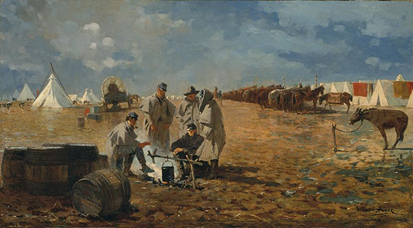
“Then I’ll do my best. You’re right. For me she is a lifeline to living meaningfully. Homer’s paintings are divided between the masculine and the feminine. Men are shown primarily at work, which is meaningful and necessary and at times inspiring. The grim side of masculinity is shown in his his Civil War paintings, as would be expected. Those paintings tend to be dreary. Rainy Day in Camp is one that shows soldiers gathered around a campfire.

In the background are tents, a row of tethered horses, and a blueish sky. The painting is colorful and wonderfully detailed yet the scene remains lifeless, ironically so given the number of men and animals. A forlorn looking mule expresses the tone and significance of the scene. War puts on hold the life celebrated by Homer—women and children and men performing useful tasks that contribute to life and its preservation rather than to its destruction. The scene is passive, but when the men and horses go into action it will be to kill other men. Homer’s paintings don’t celebrate war as a glorious enterprise and soldiers as idealized warriors. His view of war and its participants is expressed in a painting title Sharpshooter. The painting shows a sniper sitting on the branch of a tree. He looks though a telescopic scope for an enemy soldier to shoot. He is depicted doing this in a cool, calm businesslike fashion. The business of war is killing, thus an enterprise counter to all that Homer values as an artist. For Homer war is a tragedy, not something to celebrate. The sharpshooter illustrates the grim character of warfare, a business that engages in mass murder.”

“Is that how you felt when you were a soldier?”

“I didn’t do much thinking as a soldier. I recognized that the killing was necessary and that was about it. The killing and destruction were morally justified because the Allied Forces were fighting the aggressor nations that started the war and would conquer us all. We were doing what the rescuer in Life Line is doing. We were rescuing civilization from anti-life forces. Of course at the time I didn’t think in those terms. Nevertheless, we were participating in a necessary evil, not only the killing of evil men but also destroying cities and by doing so killing women, children, and other civilians. War is a grim enterprise. And important to our discussion of war, it’s necessary to recognize that war is no more an aberration of human  behavior than a sea storm is an aberration of the sea.”

“You mean it’s natural.”

“History seems to say so.”

“That’s unpleasant, something I would like to know more about, but I must ask if your role in the war was like both that of the sniper and that of the rescuer in the Life Line.”

“Good point. I would say yes. The men I fought with were good men engaged in an enterprise that was not immoral nor wanted by them. Their sacrifice was both good and heroic, but did require loathsome behavior that dragged the men into a primeval discord that reduced them to worse than beasts. To me the war dragged humanity back to the Stone Age. And there was no escape. One became a beast in order to fight beasts.”

“So what were the revelations of the two paintings?”

“The two paintings show two roles, perhaps the two sides of masculinity, one associated with preserving life, the other with destroying life, anti-life really.

“And the woman in the Life Line painting represents life.”

“To me she does. Her red scarf indicates that. She represents everything associated with domesticity, and I don’t mean just taking care of the home but family life in general, including the domesticity of creatures, which is their ultimate purpose in life—to produce life and to sustained and protect the life they produce.”

“But creatures also take life.”

“To kill is not their primordial motivation. It is necessary to accomplish their primordial task, their preservation as a species .”

“To provide for and protect their offspring and other members of the herd or pack.”

“I don’t think most creatures are aggressive by nature. Their aggression is motivated to achieve some benefit—such as food, females, and defense. Humans are rather unique in their valuing aggression for itself own sake, even going so far as creating cultural forms such as religion and art that celebrate aggression.”

“Men primarily.”

“Yes. We consider masculine aggression as normal. Not so for women. Certainly not for Homer.”

“And his paintings show that?”

“They show women working in fields. In the paintings of soldiers there are no homes, fields, children, or communities. War cuts men off from all that. Thus, war cuts men off from life as a primordial value. Their role becomes that of the raging sea in the Life Line painting. Even nature becomes irrelevant except as an obstacle or benefit to killing the enemy or avoiding being killed by him. War can change one’s perspective on life. Furthermore, the female represents beauty, whereas there is no beauty in the image of a sniper in a tree or of dead soldiers, which apparently Homer never painted.”

”And you would agree.”

“That's one of the lessons I learned from my experience in the war. There is no beauty in death and destruction. Perhaps the wise Mr. Sage knew that Homer’s paintings would be especially meaningful to me because of my war experience.”

“We were discussing religion and you mentioned three paintings having to do with the sea. We’ve discussed only one, but not in the context of religion but in terms of masculinity and femininity.”

“You do have a good memory. And those painting were...?”

The Life Line, The Wreck of the Iron Crown, and Cast up by the sea. You said Homer makes no specific references to religion, but apparently you find a connection in those paintings. So how are they connected in terms of religion?”

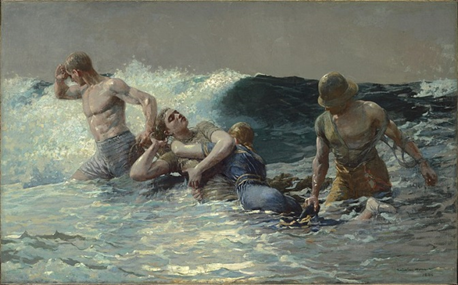
“Okay, I think I’m back on track. We see in The Life Line a man rescuing a woman, who without his aid would drown. Being young, sensual, and pretty she represents one of the primordial glories of life. The painting is saying that without her there is no life, which is clearly depicted in the war paintings of men waiting to kill. The Wreck of the Iron Crown shows about a dozen male rescuers risking their lives to return to the ship to rescue a single sailor who had been left behind. And the painting Undertow shows two men rescuing two half-drowned women.


None of his paintings show better the ideal relationship between the two primordials of the human lifeworld, femininity and masculinity. The women are soft, sensual, life-giving and vulnerable thus represent life. The men are muscular and able to confront the force of the ocean to protect life. In their effort to save the two women they become heroic. Thus, I see the painting showing the value of women to be inherent, beyond just being living creatures, whereas the value of the men is linked to their being protectors.”

“You mean the value of men isn’t inherent?”

“It’s primordial but still a choice. Life itself has inherent value, but I’m speaking of primordial gender roles. Both men and women can become artists, scientists, and doctors, but the primordial role of men has been that of protectors and providers, sustainers of life, which requires action, whereas the primordial value of women is their association with life itself. Homer could have used men or even children instead of women being threatened by the ocean. But then the painting would have lacked its primordial significance in terms of masculinity and femininity. And the woman represents beauty. Clearly, Homer considered beauty as an absolute value. The task of men should be to preserve life and beauty, not to destroy them. But it is not inherent. They must choose how to use their masculinity, to be protectors or destroyers.”

“As they do in war.”

“Yes. In war they fight either as protectors or aggressors.”

“From what you say, Homer was a big fan of women.”

“Certainly his paintings say as much. He saw women in a way we don’t seem to anymore. Most are pretty and even beautiful, some sensual, but he never presented them as sex objects. In that regard, Perils of the Sea is the painting of his that best expresses his adoration of women.

It shows two worried women standing on a pier looking out at a stormy sea. A group of men stand below them. One is pointing, most likely to a fishing boat in distress. The men are rescuers and the women are waiting for a loved one. What can’t be seen is the boat that is at risk. To me, the women are symbolically two Marys.”

“Mother of Jesus and who else?”

“I was thinking only of the mother of Jesus but we could include Mary Magdalene. The women are concerned about the men on the boat, perhaps husband, boyfriend, brother or father. What struck me is that the women are dressed in blue, the color associated with the Mary.”

“And what does their wearing blue mean?”

“That femininity is sacred.”

“Then Christianity got it wrong.”

“By worshiping masculinity rather than femininity?”

“Yeah.”

“As a primordial, masculinity never proved itself worthy of adoration. And when it is, it’s always in a destructive sense.”

“But Jesus wasn’t destructive.”

“No, but those who worshiped him were.”

“Do you think Homer saw women in that way?”

“His paintings seem to say so.”

“And men?”

“They are praised, not adored. In Perils of the Sea the two women are not associated with sensuality but with the primordials of love, family, and life. They are also sacred because love, family, and life are what the men at sea risk their lives for. Nothing else.”

“That way of viewing of women is a lot different from how they are presented today in magazines, movies, and music videos today.”

“Very much so. His way of understanding women is similar to the way the ancient Greeks did. How ironic that Greek statues of naked women, goddesses but human women nonetheless, are not erotic.”

“I agree, though some men would see them in that way.”

“Simple minds, yes.”

“Why aren't those statues erotic?”

“I think, though I’m not certain, it was because they were not to be understood in the context of sex.”

“As women are today are.”

“A change that is rather recent, at least in America. Until then, Homer’s view of women was the norm in America. Yes, there were saloon gals to entertain the lonely men of the Wild West. They performed a necessary niche role on the frontier, the outskirts of civilization populated mostly by unmarried men. But being a saloon gal wasn’t the role of women celebrated by the country’s culture. And it may be the case that these temporary female companions were not looked down upon as sex objects by the men who appreciated their company. I say that because I don’t believe the country was as obsessed with sex as it is today. In fact, even rather recently Hollywood produced movies that continued to venerate women as sublime beings.”

 “Which movies?”

“Sam Wood’s Our Town and Elia Kazan’s On the Waterfront.”

“Who were the women?”

“In Our Town Emily Webb and Edie Doyle in On the Waterfront.

”Sorry but I don’t know those movies. I didn’t go to the movies growing up and my dad watched only westerns TV.”

“That’s understandable. The movies are old. But if your father is a fan of westerns you might have seen My Darling Clementine.”

“Oh yeah, more than once. And Clementine is the woman.”

“Yes, and Chihuahua, a hot-tempered but lovable saloon gal who isn’t presented as a sex object in the movie. She loved by Doc Holliday. And those depictions of American women are very similar to Homer’s. But by the time of On the Waterfront came out in 1954 that view of women had pretty much disappeared from American culture. A cultural paradigm shift occurred.”

“I understand that they were traditional icons of femininity. You see that in the many of the paintings of other artists such as Singer Sargent, George Caleb Bingham, Mary Stevenson Cassatt, and Elizabeth Nourse. But what was lost in the transition?”

“I think it comes down to the disenchantment of femininity. The women of the Greeks and of Homer are enchanting for two reasons. Beauty made them supernatural but not in the religious sense but because beauty is subjective thus transcends materiality. Second, they possessed the ability to bring life into the world, which was to older cultures quite mysterious, as it should be. Thus, women were linked to life, beauty, home, family, tribe, and the continuation of a culture. The Greeks recognized the role of women as sacred, again not necessarily in the religious sense. In fact, it seems that the ancient Greeks, along with other pagan cultures, deified the role of women by inventing goddesses to represent them. And that had to give women status that would make it difficult to view and treat them merely as sex objects, which really is a trivial way of viewing and treating women.”

“So what happened?”

“Judaism for one. The Jewish religion celebrates masculinity, not femininity. Goddesses were reviled and banished and replaced by a deification of masculinity—Yahweh. That Greek statues of goddesses were defaced by Christian mobs illustrates the Abrahamic religions’ hatred of the feminine as does their masculine God Yahweh, shown by his cruel treatment of the plucky ingĂ©nue Eve. With Judaism women fell from grace. They became servants of masculinity rather than the other way around.” 

***

 “And Homer's painting The Return of the Gleaner can help us understand the female-nature relationship because it shows the gleaner to be at one with the natural world that surrounds her.


And he must have considered that relationship to be profoundly meaningful because it shows up in many of his paintings, including The Gulf Stream.”

“Okay, I’m curious. You must explain that relationship.”

“I would love to. I’ll use The Return of the Gleaner because Homer uses symbols to express that relationship.”

“That would be great, but before you do I must ask why Homer’s paintings are so personally important to you, because they clearly are.”

“I was surprised by how deeply they spoke to me. I love his paintings because they are enchanting and because I agree with what they say about the human relationship to the Earth-world. Perhaps it’s also a bit of nostalgia.”

“For when you were young.”

“For a way of life that preceded even my own. A time and place that was of Homer’s, one he celebrated.”

“But you believe he knew the world was changing—becoming modern.”

“Most thinkers of the nineteenth century knew that. I don’t see how he couldn’t have known. I believe that knowledge must have partly inspired his paintings, but I can’t say for sure.”

“He paints a way of living that is precious and irreplaceable, yet lost in time.”

“Nicely put.”

“It’s odd how your thinking is so modern yet you’re really not a modern man.”

“Christine, you should have been a psychologist rather than a painter.”

“No. I’m too much like you and Homer for that. Besides, I find it difficult managing my own life.”

“But you’re right. I’ve lived a modern life in a modern world. I grew up in a modern city, fought in a modern war, lived aboard modern ships. And in a way I didn’t give my world much thought until I started reading.”

“And Homer’s paintings spoke to you about another way of living, another way of relating to the world?”

“They did. They spoke to me of a world I never knew and wish I had. You know I’ve never had the opportunity to discuss Homer’s paintings with someone until now. Not even with Mr. Sage. And I do enjoy talking with you. I know that you will agree with my appreciation of Homer’s work because you too are an artist.”

“Still, I learn from you what I didn’t learn in art classes.”

“In what way?”

“Your interpretations are more philosophical and less technical. More than that,  having lived in the wild lands of New Mexico I know something about the world appreciated by Homer. The world you call primordial. But let’s not drift away from your analysis of The Return of the Gleaner.”

“Then let’s begin. What I see in the painting is a primordial unity between the woman and nature—not simply in the fact that she is a peasant doing agricultural work. First of all, the rhythm of her work is determined by her physical relationship with the nature, not by the requirements of a machine. She holds a hay fork, which is a tool, not a machine. The difference is important. The hay fork doesn’t separate her from the wheat in the way a tractor or combine would. More symbolically, the woman’s head scarf is the same shape and color of the clouds. Her blue apron is the color of the sky, and it and her dress are stirred by the wind as is the wheat in the field. So to me the painting says she’s as much a part of nature as are the clouds and wheat.”

“Do you think viewers would see that?”

“If that’s what they’re looking for or sensitive to. They would if they were of the frame of mind that allowed them to see the unity of the woman and the rest of nature. The female-nature relationship is pretty universal.”

“So you’re interpretation sees the painting from a gestalt perspective.”

“I think so. Otherwise, the focus of the evaluation would be on the significance of the woman. She is front and center and her feminine presence dominates the painting. One could argue that she is a symbol of fertility inherent in nature.”

“A Demeter figure.”

“Exactly, and there is a paganistic quality to many of Homer’s paintings.”

“No references to Christianity?”

“Not in the book I read or in the paintings of his that I saw. There are country schools but no churches. I believe his worldview is contrary to Christianity, which considers humans essentially spiritual beings radically separated from nature. Whereas for Homer farmlands, pastures, forests, rivers and the sea are people’s primordial the settings, Christianity divides the world into the natural and the supernatural and the two are considered incompatible. The proper dwelling place for humans, at least mentally, is the supernatural experienced by going to church, reading the Bible, or praying. Eve turned away from the supernatural when she was drawn to a tree in nature. For that, the Bible has her punished. Christian morality demands separation. The First Epistle of John says, ‘Love not the world, neither the things that are in the world. If any man loves the world, the love of the Father is not in him. For all that is in the world, the lust of the flesh, and the lust of the eyes, and the pride of life, is not of the Father, but is of the world.’ The flesh world is the material world. Thus, the Christian worldview is totally incompatible with Homer's.

 From Frank Kyle's unpublished The Girl and the Philosopher.