Dedicated to D-Day Heroes
I’m confessing that I’ve never published a book with a conventional publisher. That’s significant because it means I have never profited from writing books. To be more precise, self-publishing is a costly nonprofit enterprise. So why do it? That’s the question I will try to answer here. First of all, a money-profit oriented society equates unprofitable with futile, useless, pointless, and worthless, but writing is worthwhile even when unprofitable. And that’s part of the answer. I’ve been unprofitably publishing books since 1995. So why do I keep publishing when doing so has been painfully unprofitable for three decades?
The answer to that question takes me back to a time long before I fell in love with books, long before I decided that I would like to write one. Is it a story you would be interested in? Perhaps if you’re a self-publishing author or you’re thinking about becoming one because it is a story about a self-publishing. Presently, I’m working on a book that celebrates ordinary people as being extraordinary for three reasons. The first is that each life is extraordinary even when ordinary because each life is a unique story. Second, living self-aware emotionally and intellectually is incredibly extraordinary, so much so that it may be unique to human beings, not only on Earth but in the Universe. Finally, each and every human being is extraordinary because it is through him or her that the world is uniquely revealed. The conscious life of human beings allows the world of nature and the artificial world of humankind to reveal themselves to a unique awareness that is intelligent, understanding, and appreciative. With it the Universe becomes self-aware.
Hegel
was perhaps the philosopher who first explored this idea in detail. He argued
that an animated idea that he called Spirit had over time a transformational
effect on the material world. He just couldn’t let go of supernatural ghost in the
machine. He followed one of the two cosmological traditions offered by Greek
philosophers. One associated with Plato and the Stoics and adopted by Christianity
has ideas preceding the material world. These ideas gave form to the formless material
mass that was the primordial Universe. The other was that of Democritus the
atomist and the Epicureans (followers of Democritus) who believed the objects of the world emerged haphazardly
as bundles of atoms without the guidance of ideas, similar to science’s
explanation of how the Universe evolved.
For
example, Hegel refers to “Logos [divine
reason] as the world-creating and world-ordering principle” and he “conceives
the idea, the spiritual principle, and the innermost essence, the true
existence underlying Nature” (A History of
Modern Philosophy, Harold
Höffding vol. 2). Höffding says that
what we find in Hegel is the Romantic attempt to suppress the mechanical conceptions
of nature. By adding to it an Absolute Spirit or Oversoul (Emerson). But that
isn’t necessary in order to preserve a romantic (sublime) view of nature
because the mechanism is glorious and gave birth to life. More than that, it
gave birth to spirit—the human spirit. Human subjectivity is the ghost in the machine.
As it turns out, it was not a supernatural Spirit but humans who transformed the material world into ideas captured in both language and art. The process of humans transforming things into ideas is the opposite of reification, which humans such as Hegel also do. The Lascaux cave paintings are the earliest ideas expressed artistically. The cave painting of a dun horse is more than just an image on a wall. The horse first entered into the mind of the artist, where it became an idea that was then reproduced on the wall of the cave. But the artist’s idea wasn’t as simple as one might think. The image of the horse is not a simple rational representation of a horse. It is the representation of a human’s idea of a horse, an idea infused with human intelligence, emotion, and sensory experience:

Let me quote Alfred North
Whitehead:
Nature
gets credit which should in truth be reserved for ourselves: the rose for its
scent, the nightingale for its song; and the sun for its radiance. The poets
are entirely mistaken. They should address their lyrics to themselves and
should turn them into odes of self-congratulation on the excellence of the
human mind. (The Concept of Nature)
Both nature
and the human organism—bodily, emotion, and mind—deserve credit. Whitehead
continue saying, “Nature is a dull affair, soundless, scentless, colourless;
merely the hurrying of material, endless and meaningless.” Of course he was wrong about that,
thus lacked the wisdom of the painter of the dun horse. Whitehead is guilty of reductionism. Yes, the world is made up of atoms, but atoms can perform magic such as transforming the atoms of
It
is true that the idea or ideas of nature emerge out of humans’ symbiotic (sensual,
emotional, and intellectual) relationship with nature. The senses of sight,
taste, touch, smell, and hearing transform the entities of the world. They do not
simply represent them as they are apart from human subjectivity, which is also
unique because unlike other creatures human are aware of their awareness. And
that reflexive awareness was first expressed in art. Yet, to denigrate nature
is the foolishness of a mind made dull by a philosophical/scientific ideology. The
sensitive mind, such as that of an artist, would see humanity’s relationship
with nature as intimate and profoundly mysterious.
The
transformation of the material world into ideas is an extraordinary event that
may take place nowhere else in the Universe. Then the ideas were used as tools
to transform the world materially via rationalization, domestication, and artificialization.
An accelerated version of the process can be seen in Godfrey Reggio’s movie Koyaanisqatsi. For better or worse the
spirit that has guided human history belongs to humanity.
And
in a way, we self-publishing authors are the most ordinary of authors, always
writing, never profiting. Nevertheless, that doesn’t mean we’re not extraordinary
human beings in love with writing. I think we are, though don’t start
celebrating just yet because I feel that way about everyone. The idea isn’t
new. The American sitcom television series Cheers
celebrated ordinary folks as being extraordinary.
Growing Up
Let’s go back to my beginning, which was World War II. Yes, I’ve been around a long while, and what I find disheartening is that I was born during the most destructive war of all time, and yet as I write there are two destructive wars raging, destroying cities, homes, schools, businesses, hospitals, and playgrounds and killing thousands of ordinary extraordinary people like you and me. It seems that humans, or at least men, can’t end their love affair with war no matter how awful and insane it is because it is a love affair motivated by hatred of others and a love of violence.
I had two fathers, a biological father and a stepfather, both served as sailors in the war of my birth. I learned very little from them. When I was seven and my brother was four, our biological father took off to Mexico to become a well-known furniture designer, sculptor, and artist so the father-son learning cycle never occurred. Too bad!

Frank B. Kyle Sr.
I could have learned much from my stepfather, but I was a teenager whose only interests were girls and cars. When my first father abandoned the family he left my dear mother with the chore of raising two boys. She had been a Rosy during the war, but factory jobs for women ended after the war. She became a waitress. No person was more ordinary than my mother, nor more extraordinary. She had her own story to tell, but it will remain untold because it died with her.
My parents were not bookish people. My mother grew up on a farm in which there was only one book. I doubt she read much from it. There was no need. They were a church-going family. The rest of the time they worked. After my first father took off, the family lived in public housing. It was a rough setting, so my mother bought a small house in Cypress, a community out in the boondocks, which meant that she would have to work day and night (split shifts) to pay the mortgage and keep the family going. There was no TV but no books either. Sometimes we had a babysitter. Once without a babysitter my brother and I set off a Smokey Joe on the kitchen table. I called my mother. She left work and drove the fifteen or so miles to find the kitchen table ruined but the house still standing. I don’t know what her thinking was at the time. I was in the third or fourth grade, don’t remember which. She must have been a nervous wreck though. When she had time she drove us to the countryside or to the beach. Her car had a music box fasten to the lid of the glove compartment.
I believe she remarried out of desperation. My stepfather was a good man but a bartender who had a weakness for drink. True to her Texas roots, Mother hated the devil's brew, even more since it had taken control of three of her brothers whom their little sister would occasionally have to babysit. I personally don’t give the Devil’s brew all the credit for their addiction. The war deserves some credit since two of her brothers, Ben and George, eventually committed suicide.

Uncle George (left) spent most of the war in a Japanese prison camp and recieved a Purple Heart. He gave me his medals. My stepfather made a frame for them. I gave them to the Dimmitt, Texas, library because I thought he shouldn’t be forgotten by his hometown.

Those men are gone as are most of the men they served with. They were all heroes who fought evil. They are my heroes. Their absence has created an emptiness that can’t be filled. Their stories left untold, but in France they have not been forgotten. With appreciation their sacrifice is often recalled. Americans increasingly live in forgetfulness. As an American I find the French attitude surprising. Such good feeling no longer exists in the U.S. fractured by hateful animosities. Republicans hate Europe and Democrats hate America as their burning of cities and opening of the border have proven. And each group hates the other.
During
the Vietnam War those young members of the counterculture movement were filled
with love rather than hatred. They rejected the government—even hated it,
justifiably so for dragging the country into an unjustified, inhumane war.
Their hatred was political. They didn’t hate America but thought of it as a
tarnished ideal that could still be achieved. Their music said as much. They
didn’t reject Europe but turned to it for intellectual and artistic guidance
and inspiration. That’s all changed. The love is gone. That America is gone.

Grenoble: Black American Soldiers who helped to liberate France. My wife’s father (with the white collar) stands between the two soldiers on the right.


The two above photos are from the French journal
Mémoire d’Obiou published May 2024
My stepfather’s house came with a TV but no books. My mother would often come home from work to find her boys asleep on the couch in front of the television hissing static from the strange symbols of an analog test screen that weirdly included a Native American wearing a headdress. The only book I recall reading from the sixth grade through high school was Old Yeller, written by Texan Fred Gipson. I read it for a book report, which my mother wrote as I dictated what I remembered from the story.
Were those lost years? Parts were, certainly. However, summers my mother would put me on the train, later a bus, and send me back to Texas to live on farms. One belonged to her sister Maurine, the oldest sibling. The other was worked by her brother Othell a Texas tenant farmer:

My life was set, and I couldn’t have been happier, an all-American guy with an all-American girl. However, the girl of my life, my fiancée, apparently wasn’t as contented as I was. Why should she have been? I was a gearhead interested in things mechanical and hunting, which I did with my (never to be realized) future father-in-law. So the relationship didn’t last. When visiting for the first and last time my biological father in Mexico, my mother’s idea, I received a Dear Frank letter. It was over. I would find out years later that my mother was partly responsible for the separation. Sending me to Mexico gave my fiancée time to rethink her future with me. My mother thought neither my fiancée nor her family were good enough for her gearhead boy, when in fact her boy was the one unworthy. My life came unraveled. I quit the factory job where my once ex-future father-in-law worked.
Good Morning, Vietnam
Working various part-time jobs, I enrolled in Long Beach City College. I wanted to be a cop in part because JFK-LBJ’s war was in full swing. To be fair, Kennedy had formally decided to withdraw from Vietnam. Like Eisenhower he knew or at least came to realize that war in Asia would become for the U.S. a messy quagmire easy to get in hard to get out. Bush would discover the same was true for wars in the Middle East. Kennedy’s assassination prevented the withdrawal. So the war really became LBJ’s war. It didn’t matter that among my age group Vietnam was as well-known as Shangri-La. I figured that if I got drafted I could be a cop in the military and then a civilian cop when I returned home if I did return home. Many men my age didn't.
However, both the draft and the war were extremely unpopular in Southern California. I too began to wonder why I would be fighting the mysterious Vietnamese. They, whoever they were, weren’t invading my homeland or anyone else’s as far as I knew. Yes, my fathers and uncles fought in that Great War of my birth, probably not happily or even patriotically, but they were at least motivated by Hitler and the bombing of Pearl Harbor. My generation was being conscripted to fight a people who had just freed themselves from the colonialist boot of France, as Americans had from the boot of Great Britain. So who were the bad guys? I felt no patriotism because my homeland wasn’t threatened. I didn’t even like the president. He lacked JFK’s charisma and good looks. Since LBJ, presidents have become increasingly hard to like. They have become what Edward Abbey calls in his Desert Solitaire the country’s ball & chain. (Actually, I believe he meant all politicians were a ball & chain. Most Americans today would agree.) And should I care if the Vietnamese became communists? It wasn’t being forced on them by outsiders. It was a revolution. Let them sort out their future, whoever they were.
Of course, I didn’t know even that much then. All I knew was that something was wrong in America, not in Vietnam, a president had been assassinated and racial unrest was everywhere. America needed to get its own house in order and had no business getting another people’s house in order with bombs. LBJ probably thought what America needed was a good war to unite the country. But it was an evil war so it divided the country even further. War resisters were condemned as evil, jailed or shot for being unpatriotic, but doing what stupid or evil politicians tell you to do isn’t patriotic. LBJ and Bush Jr. fall into the stupid category, though the consequences of their actions were evil. Vladimir Putin falls into the evil category pure and simple along with Hitler and other evil men (always men!). However, patriotism (the belief that so-called national interest is above all else or America is First in all things) can be overridden by morality. For Vietnam War resisters and protesters morality trumped patriotism (at the time a meaningless term). Biden’s motivation for helping Ukraine is essentially moral—Good Samaritan morality, aka, altruism. However, national interest is a consideration. Ukraine’s losing the war would mean Europe and U.S. losing as well. As a result that axis of evil Russia, China, North Korea, and Iran will grow even more confident as their egos are further inflated.
The Book that Changed my Life
Books can change lives. In my state of limbo, I ended up taking by chance a philosophy class mostly because I thought it would be easier credits than math, economics, history, biology or English. The teacher was Paul F. Fink, the book, his, was The Challenge of Philosophy, a collection of philosophical essays. It was the first book since Old Yeller to capture my attention. It turned my life upside-down and put it on a totally different path. Or should I say it gave my life direction which it lacked ever since my first girlfriend and never to be wife was no longer a part of it. I was in limbo like most the guys my age at the time. That’s the thing about wars. They put on hold the lives of the ordinary people they don’t kill.
I still have the book, though my teacher must be long dead. That’s the one thing I really hate about growing old—almost all the teachers, friends, aunts, uncles, and even cousins I long ago shared my life with are gone. The first essay in the book is by Plato, but it’s about his teacher Socrates, who explains the philosophic enterprise, which is simply to doubt anything you’re being told until you can know it to be true or at least probably true. Next was René Descartes’ essay on doubt, again that all claims should be doubted until proven to be clearly and distinctly true.
But the kicker was Jean Paul Sartre’s essay “Existentialism is a humanism.” Sartre says that humans come into the world as nothings (nothing in particular like a slab of marble waiting to be carved into a Venus de Milo), and that it’s up to them to transform their nothingness into something. What he means is that we come into the world as pure potential that is (or isn’t) realized by the choices we make. Plato provides the three general categories of potentiality that humans have to work with—physical, emotional, and intellectual. Humans are unique because other animals don’t make choices. They follow their instincts and conditioning. Christians, of course, disagree. To them we’re all God’s children. But Sartre was an atheist. As for me, whether or not God exists seemed irrelevant. I lost my high school sweetheart, my job, my never to be future in-laws, and was threatened by a war caused by a president I didn’t even like. It was his war, not mine. But the draft, working for the Grim Reaper, was a vortex pulling young American boys into its maw.
Back to self-realization, Plato’s three categories are similar to an artist’s palette. Like colors each category has endless possibilities (hues if you will) for self-realization, and of course they can overlap to create new possibilities. In addition, individuals can realize any number of their potentialities. High schools and colleges help students to discover, know, and pursue the endless possibilities of self-realization open to them. At the high school where I taught students could pursue athletics, the arts, and intellectual disciplines such as science, history, and language. And of course there were various opportunities for emotional expressions. The comradery of sports, dramas, musical performances, journalism, and clubs of various kinds encouraged friendships. And occasionally high-school romances blossomed. I knew students who did it all. An important characteristic of American high schools and colleges is that they provide the freedom of choice and knowledge that enable students pursue multiple possibilities for self-realization. The freedom to be whatever one wants to be is absent in many cultures and nations.
Becoming a Vagabond Scholar
Mr. Fink’s book caused in me what Buddhists call an awakening. I thought I had always lived in an awakened state, but that wasn’t true. And having become awakened I certainly didn’t want LBJ’s war to take control of my future, a war that ended the futures of 58,220 young American men and of a couple million Vietnamese. So I decided to pursue philosophy rather than law enforcement. However, that choice also took me in the direction of writing. My writing skills were poor as I embarked upon a bachelor’s degree, but they would improve slowly because philosophy students are required to write endless essays.
I always dreaded essays and term papers, most likely because they are graded. I also found them difficult to write, and term papers required research, which required being on campus and having access to a library. What I didn’t realize was that I was acquiring unknowingly writing skills that would later benefit me as a self-publishing author. An important unpleasant feature of college essays is the deadline. Late papers are refused or penalized. So students always write under pressure, but they learn not to procrastinate if they want to succeed in college. What is learned from the torment of being forced to write? One learns to continue to write even when one would rather not. Writing isn’t always a holiday. Sometimes, often really, it feels like work. The pain comes not with the topic but with working with language to craft ideas and experiences into words in the way a painter works with paint to do the same.
Why do self-publishing authors put up with the pain of transforming thoughts into words when they know there will be no pot of gold waiting for them once the writing and publishing process is completed? It’s the love of the topic or the medium—words. In San Diego I saw many amateur painters painting seascapes. They knew their paintings would never sell, but they loved painting (the colors themselves—like words—are inherently wonderful) and they loved the seaside they were painting. A characteristic of painting that look-&-click photography lacks is the length of time devoted to observing the object one seeks to capture. It’s like fishing. What is most enjoyable about trout fishing is not catching the fish (which will have to be killed, cleaned, and cooked) but the enchanting setting of lakes, rivers, or streams surrounded by blue sky, clouds, and trees. Painters enjoy the company of the scenery they are trying to capture on canvas. Painting is not simply an act of recording an object of fascination but a way of relating to that object, to the world generally. Writing is similar. It is a slow, in-depth process, a more abstract process because it relies primarily on ideas and words. What the writer keeps before him or her is an idea of a thing, creature, scene, or person.
An art teacher who taught with my wife wrote a memoir of her father, who was a member of America’s Greatest Generation who like my fathers fought in World War II but as a soldier rather than a sailor. By writing the memoir she was able to spend time in memory with her father. The experience was nostalgic, poignant, and meaningful. And the memoir was self-published. Writing allows writers to spend time with that which they love. Critics complain that self-publishing is not cost effective and may even result in a writer’s publishing a work that is considered substandard. So they advise that self-publishing is a road that leads to nowhere, ultimately to a dead end. Thus, they recommend that one should pursue only traditional or conventional publishing.
Their advice ignores four realities associated with self-publishing. First, the vast majority of published authors, about 97%, can’t make a living writing, including those whose books are published by conventional publishers. They need a day job, usually teaching, to survive. Second, even a higher percentage of writers DO NOT have access to convention publishers. They must attempt to go through agents who serve as a firewall that filters out 99% (or higher) of the works submitted to them. Agents are not evil people. The problem they face is that computer technology has created thousands of additional writers. Sometimes I think that there are as many writers as there are readers. In addition, reading has declined as publishing has increased. (For self-publishing the increase was “61,000 titles per year in 2006 to 235,000 titles in 2011.”) As a result, literary agents are inundated by aspiring writers; thus, if most writers want to write and publish, then they must self-publish. This situation makes dealing with agents both frustrating and time consuming with little to no hope of success.
Third, conventional publishers limit the range of self-expression. Their interest in books is limited by what is apropos to their financial interests and to the political, ideological, and cultural preferences of their readers. Thus readership preferences take preference over ideas. Over 80% of the US trade book market is controlled by Penguin Random House, Hachette, HarperCollins, Macmillan and Simon & Schuster. This means that when it comes to the written expression of ideas conventional publishing is more exclusive than inclusive. Self-publishing publishers are more welcoming to a wider range of ideas thus to a greater number of authors.
The self-publishing community is similar to the underground press movement that emerged in the United States during the Vietnam War. A friend of mine Ray Mungo was a writer for the underground press and describes his experience in the memoir Famous Long Ago: My Life and Hard Times with Liberation News Service. It was a time when both books and ideas mattered to young Americans. Self-publishing publishers make possible the expression of ideas rejected by conventional publishers either because the ideas are unwanted or because the readership is too small to justify a financial investment. In a sense, if a writer wants to be published by a conventional publisher, he or she must write for the publisher and for the audience the publisher caters to. The writer’s interest in his or her topic is irrelevant.
Fourth, self-publishing authors often simply want to write. As one myself, I will say that I’m not especially interested in my books being read. It’s the writing I enjoy along with the subject matter, which includes fictional situations and characters.
Subjectivity
Then why do I bother to publish at all? Good question, but I have an answer. But first I am going to rephrase the question in order to respond from a different yet similar perspective: “Why spend years building a hot rod that can’t be driven on the streets or anywhere else?” My answer begins with subjectivity.
Subjectivity makes all humans extraordinary. It may exist nowhere else in the Universe, not even among non-humanoid creatures such as birds. Subjectivity in non-human creatures serves to make them aware of their environment and by doing so improving their survivability. Still it does more than that as any pet owner will tell you. In the story Old Yeller, subjectivity makes possible the friendship between the boy and his dog. Language however transformed human subjectivity into a substance that improved understanding but also enabled the objects of awareness to be concretized into words: “Rose is a rose is a rose is a rose.” Via subjectivity, words attach themselves to objects a person considers to be important—sensually, emotionally, and intellectually. It is interesting to compare the writings of Ernest Hemingway and Virginia Woolf. Hemingway was interested in the external world of experience. Thus, he wrote like a journalist. Woolf was interested in internal world of subjectivity. Both were concerned with the lives people live and their responses to the world they live in: to love and death, war, nature, friendship, beauty, and so on. Hemingway describes the world realistically or concretely in the way John Constable does in his painting Wivenhoe Park. Woolf describes the world as influenced by subjectivity in the way Claude Monet paints a sunrise in Impression, Sunrise.


Robert’s Hot Rod
My brother had a neighbor named Robert who spent twenty years or longer transforming a Ford jalopy into a beautiful hot rod that looked something like these:

Whatever
his motivation, Robert transformed a commercial machine made to serve a
practical purpose into a work of art. Yet, further thought reveals that cars
are deserving of, if not love, at least profound appreciation. They give humans
a form of personal transportation that is similar to that possessed by birds.
It is truly an extraordinary machine. Misused, it can of course be dangerous as
James Dean, also of our era, found out. Yet, it allows ordinary people to freely
explore landscapes that they may otherwise never see and to do so up close,
thus visible to appreciating eyes. I remember the old Chevy slogan: “See the
U.S.A. in your Chevrolet.” That seems trite, but it isn’t. The automobile gave ordinary
people an extraordinary personal means of exploration appreciated especially by
Americans. Automobiles go where trains, planes, and buses are unable go because
they must follow predetermined routes. But not so the automobile. The
automobile is truly an instrument of freedom that in America allows every man
and woman to embark on adventures from sea to shining sea.
But Robert didn’t use his show car for the purpose it was originally designed—transportation. He found another purpose that wasn’t practical but artistic. It was a project costly in time, devotion, and money but also a project that gave him infinite satisfaction. (Human satisfaction is another amazing phenomenon that may exist nowhere else in the Universe yet is taken for granted.) Humans often engage in activities that are costly and impractical because they give their lives another purpose related to self-realization. Many self-publishing authors pursue writing because writing to them is inherently meaningful even when unprofitable. And they publish their books with self-publishing publishers for the same reason Robert would tow his car to distant car shows—to show off his beautiful, useless creative work. Where is Robert’s car today? I don’t know, but I hope it hasn’t disappeared with its creator.
Reading and Writing Books Are Adventures
And
one of the earliest and greatest literary adventures is Homer's The Odyssey. It is not only full of
surprising events but each one illustrates for the reader an important idea or
lesson. Yet, any story is an adventure into the unknown. In my novels about
Christine’s adventures there is an elderly bookseller who spent his entire life travelling only vicariously in books:
I have to chuckle a little when I think about Mr. Sage who, apparently, lives totally in his little world of books. Perhaps you have seen the painting by Carl Spitzweg titled The Bookworm. I can’t imagine a better illustration of our bibliophile. The bookworm is shown standing on a stepladder surrounded by shelves of book. He holds a book in each hand, one of which he is reading nearsightedly, another one under his arm and still another between his legs. Like me, Mr. Sage is a story dweller, except he has lived a thousand stories. In fact, the bookworm in Spitzweg’s painting could be standing in Mr. Sage’s mind, which is itself a mental library. As a disembodied spirit I find his bookish life a little incredible. Given the opportunity I would abandon the world of books and enter into the real world where one breathes the cold, clean air of morning and feels the flesh warmed by the sun. But I like this Mr. Sage, nonetheless. He and I are cousins, in a way. He almost seems disembodied himself, his flesh burned from his soul by a thousand books. And that cramped little bookstore! I imagine it would be like living in a dusty, dimly-lit cave.
Yet it is a world, many worlds really. The little bookstore is like a galaxy filled with thousands of new and strange worlds, each one waiting to be explored. So Mr. Sage’s world is not so small after all, much larger than what most people would imagine if they entered the store and saw Mr. Sage sitting at his tidy oak teacher’s desk, reading one of his own volumes. My guess would be that he would remind them of a little mouse sitting in its tiny hole in the wall, nibbling at a bit of cheese, but I don’t believe such is the case at all. In fact, being a story dweller myself, I think of Mr. Sage as a cosmic traveler, ranging through space and time, exploring world after world just as if he really were a disembodied spirit. One day he is marching with Caesar’s legions against the rude warriors of ancient Britannia, the next day journeying with Bashō along the narrow road north that leads to spiritual enlightenment, and the day after that traveling to the edge of the cosmos to visit the Star Maker and to look upon the face of God.
It should be obvious by now that the interior of the bookstore is quite deceiving to those who are not story dwellers. It is not a dead end as some would believe, but a place of departure, like a train or bus station, better yet a space-time portal, each book a journey and destination. Yes, Mr. Sage’s little bookstore is not exactly what it appears to be. It is another world, or other worlds that Mr. Sage inhabits, hyper-realities created from language, if you will. I wouldn’t call it a higher plane, but it is a purer one. The air is thinner so one can see farther, and it is easier to travel about. That’s because books actually do burn the flesh from the souls of readers, allowing them to take wing like birds freed from their cages to explore the vast worlds of human experience across the boundaries of time and space. It is the mind that enables the individual to overcome confinement to a particular position in space and time required by bodily existence, but the space and time of books are infinite realms of the imagination that allow the souls of readers to roam freely.
And because books are written, the journey is always through the realm of the mind, someone else’s mind, that of a fellow traveler like you my good reader... Still, though the journey is a mental one, spiritual if you like, it is no less hazardous than traveling through the concrete world. I was about to say the real world, but each possesses its own reality, and thus is capable of harm. The hazards that lurk in the realm of ideas differ from those of the concrete world. Mr. Rieneau and Mr. Sage, both experienced explorers, have suggested that voyaging into the darker regions of thought, the soul is exposed to conceptions that can cause it to become dismayed and forlorn, devastated and heartbroken. Ideas, presented in their pure form or cloaked in narrative, can buffet the soul, leaving the individual dispirited. The resulting pain is no less real than a physical wound. Consider the pain caused to the body by death and disease, yet is it any less severe than the spiritual pain caused by the soul’s understanding of the meaning and significance of death and disease? You may recall Mr. Sage’s account of the sorrow of Gilgamesh that resulted from the death of his friend—Enkidu. That sorrow was for himself as well.
The Problem of Nihilism
My first book was written for my master’s thesis that investigated the problem of nihilism in the works of Turgenev, Kafka, and Hemingway. The project was an adventure that took me into the three worlds—created from the substance of each writer’s era, ideas, and experiences—that were very different. Then there were the fictional worlds created by the writers themselves, Turgenev’s Fathers and Sons and Smoke, Kafka’s The Trial and The Castle, and Hemingway’s The Sun Also Rises, A Farewell to Arms, and short stories to mention only a few of their works I read. It was truly an adventure into the unknown that also reveals that no one reads more than writers do. So the literary adventures of writers include both reading and writing.
If given the time I may address nihilism in greater detail, but before leaving the topic here I must say this. Nihilism (that all values are baseless/everything is meaningless) is an idea, nothing more. And it’s not an idea that is logically true in the way 2+2=4 is logically true, nor is it empirically true in the way “Emma Thompson is a British actress” is true. Yes, life is tragic, but it isn’t nihilistic. Otherwise, it couldn’t be tragic. Certain events are considered tragic because they involve the loss of that which is considered of great value. Besides, simply watching people live reveals that to them life is full of value and meaning. If nihilism were true, then great art would be without purpose. And it’s not, except to dull-minds or those infected by nihilistic thinking. It is true that severe physical or psychological suffering can isolate the sufferer from life’s value and meaning, but the value and meaning are still there. Of course, dull-minded male politicians can, have, and continue to destroy sources of value and meaning by killing people and destroying communities. It should be obvious that these killers and destroyers are evil, as are the people who willingly follow them. Their value is truly nil.
The most diabolical causes of nihilistic thinking are religious and secular ideologies. Their nihilistic claims are, of course, false. For example, the Abrahamic religious ideologies declare that non-believers (ironically including one another) have no value or, worse yet, have negative value. For example, Old Testament ideology declares pagans (non-Jews) as worthless and deserving of destruction. New Testament ideology declares non-Christians (pagans and non-Christian Jews) so worthless that they deserve to be tortured for an eternity in a lake of fire. Christianity adds—via Apostle Paul—that the material world, including Mother Earth and the flesh (the source of our existence but also endless forms of pleasure given by the senses) are inherently worthless and sinful because they are of the flesh rather than of the spirit (which exists only as an idea). Finally, the ideology of Islam declares non-Muslims to be infidels who are so worthless that they are an abomination to their God Allah, who also has prepared a lake of fire with which to torment them forever. All three ideologies have engaged for centuries in jihad against non-believers.
Secular ideologies such as fascism and communism have done and continue to do exactly the same thing. Hitler, Stalin, and Mao used their false ideologies to justify murdering millions of people declared worthless according to the ideology. Nihilistic ideologies continue to falsely declare that billions of people are without value or of negative value and as such can be justifiably destroyed either by death or conversion (indoctrination). For centuries ideological nihilism has been an unnecessary source of tragedy inflicted upon human beings (and often other creatures such as black cats, owls, bats, animals with cloven hooves, crows, snakes, etc.) by dull-minded men who use the ideologies to justify their wills to power. Truly, the dark side of humanity is that humans have chosen to be nihilistic by denying value to others or attributing negative value to them just because of an invented idea that serves their hatred and wills to power.
Feminism & the Extraordinary Lives of Ordinary People
My second book began as a dissertation titled Dear Ruth: An Existential Novel Exploring the Themes of Nihilism, the Outsider, and Feminism. When I began writing this novel (378 pages), I had no idea where it would take me. Clearly, my interest was still philosophical. Yet, my philosophical interest grew to include feminism, not political feminism but ecology, ethics, and ontology from the perspective of women. I had come to the conclusion that generally men and women experience the world about them differently. Virginia Woolf was a huge influence as was Ursula K. Le Guin in part because her parents were authors Theodora Kroeber and anthropologist Alfred Louis Kroeber, whose books I read because of my interest in Native American cultures.
I also have to include Alice Walker, author of The Color Purple, who visited the University of New Mexico. I was moved most by the force of her personality. Thus, the purpose of Dear Ruth was to attempt to see and experience the world through the lives of the story’s female characters Christine and Ruth. Their responses are intimate, innate, and intuitive as are their ideas. The intellectual or bookish understanding of the world comes from an old fisherman, Mr. Rieneau, veteran of World War II, retired seaman, and earlier in life an insatiable reader of books. Eventually, he and Christine find common ground in ideas derived from experience and books. Their differing genders contribute to the uniqueness of each’s experience of life. However, a central theme of the novel is that the uniqueness of people’s lives is a composite of gender, life experience, and intellectual and emotional growth. Equally important is the complementary theme that though every character in the story is ordinary, he or she is also extraordinary. They belong to the class of people that make up most of humanity, the people I’ve associated with my entire life, no one like Joan of Arc or Alexander the Great. Yet most heroes are not superheroes but ordinary people who act in an extraordinary fashion to benefit others.
Thus, I wanted the story to reveal how men and women experience the world differently and how ordinary people live extraordinary lives, lives that are heroic if only because for most people life isn’t easy.* And truly who are heroes? They are the people who choose to devote their lives in some fashion to benefit others. Parents are the first to come to mind because they are humanity’s primordial heroes. But there is also in Christine and Ruth’s story something more about ordinary people being extraordinary that takes the reader into the realm of science and philosophy, the fortes of the old fisherman. In other words, ordinary people are ontologically extraordinary.
*In his novel The Man Who killed the Deer Frank Waters presents the most ordinary of men, an alcoholic Pueblo Indian named Panchilo known to his people as Scarecrow. Waters recognizes that Panchilo is an extraordinary human being because he has lived and suffered and now loses himself in alcohol. How so extraordinary? Let’s follow him. With his bottle of whisky he retreats to “a little rise beside road” where he “sang, looking down across the fields, upon the desert.” What did Panchilo see? Waters gives us some idea: “The sky was a light green turquoise, the mountains deep blue. The snow was melting. The soggy earth smelled rich and fresh. The edge of the wind was dull; winter had lost its temper. A bird sang in the thickets.” In his moment of intoxication Panchilo becomes one with the earth—as his people had always been. In that moment of oneness he saw, felt, and understood in a way most people never do. Thus he sings. That is what makes the ordinary Panchilo extraordinary. And Frank Waters knew that.
But there is more. Martiniano, another character in the story who rescues Scarecrow, has a vision of a deer. The deer, Waters tells us, is gray with black nose and ears like petals, with marking of black and a little splotch of white under the left shoulder that continues down toward the belly. Martiniano “stood there, as a man stands before a miracle, with a calm acceptance of the mysterious made commonplace.” It’s a vision but also reality. All creatures are miracles, as are all the forces and entities of nature that make up the world in which creatures live.
My next book was Hemingway and the Post-Narrative Condition, which argues that The Sun Also Rises is an early illustration of the postmodern condition. Simply put, a paradigm shift began to occur after World War I that would influence the evolution of modern societies. The new paradigm was labeled postmodernism. The seminal and most readable introduction is Jean-François Lyotard’s The Postmodern Condition. What Lyotard does is call into question all the religious and secular grand narratives that people have allowed to tell them who they are, what they should think, and how they should live. In a sense, postmodernism is an existential project that began with Socrates, the purpose of which has been to enable people to achieve some critical distance from the endless invented ideologies, belief systems, fads, and fashions that take control of their lives—often destructively so. The goal isn’t to prohibit adopting such belief systems but to let people know what they are getting into when they choose to surrender their lives to such belief systems.
In The Sun Also Rises it’s an event rather than a philosopher that calls into question all belief systems based on religious, political, and nationalistic ideologies—World War I (20 million deaths; 21 million wounded). That is why the World War I generation is called the “lost generation,” a phrase coined by Gertrude Stein and used by Hemingway in his story. The story shows how people live when they no longer adhere to a belief system associated with a grand narrative. For example, the main character, Jake Barnes, has lost his religious faith. What takes over ranges from impulsive behavior to nihilism. With no grand belief system to guide their behavior people tend to rely on their senses and emotions to dictate their thinking and actions.
As postmodernism evolved it became more playful and liberating, as the story illustrates. The conflicts and chaos that occur in the novel occur among individuals, not nations. Postmodernism doesn’t inspire wars—religious and secular ideologies and authoritarian political systems do. So, somewhat ironically, though the novel casts a critical eye on both war and the post-narrative condition, it may also be offering them as an either-or option for modern society. From a positive perspective the postmodern “lost generation” may be less lost than liberated from destructive Grand Narratives. However, war remains the primary culprit in the story because it prevents the consummation of the great love affair that occurs between Lady Brett Ashley and Jake Barnes. And, as we see today, history has ignored playful postmodernism as an alternative to religious, Marxist, and nationalistic grand narratives that encourage war.
Hemingway and the Post-Narrative Condition was followed by an enlarged edition that examines the philosophical implications of Hemingway’s novel in greater detail. (Photos of both editions are below.) Still, the big question that continued to linger was what can replace the loss of the conventional belief systems that historically were ideological sources of meaning for people’s lives. The novel offers a solution, but it’s limited by the narrative. One of the features of the novel is that it encourages philosophical investigation, but it is not a philosophical work but a story. And I doubt that as he wrote the book Hemingway had an idea such as postmodernism in mind, which prevented the story from being compromised by philosophical digressions, which do occur in my novels. Thus, another book was necessary to explore further the philosophy latent in the novel. So I felt the need to write:

Books Have Lives of their Own
That is why I don’t want my books to disappear, at least until I’ve disappeared. Vanity? Perhaps. I know my books are not great works of literary art. I’m not a Hemingway or Virginia Woolf. Having pursued a master’s degree and a doctorate in literature I’ve read many if not most of the great works of literature, beginning with Epic of Gilgamesh and Homer’s poems. The answer is that my books are my friends, not the physical books but what’s inside them (including characters, how weird is that!). The books on The Sun Also Rises evolved over a period of three or four years. Two of my novels took a couple years each to write. Authors spend a lot of time with the books they research and write and thus with the topics they write about. And clearly they are writing about something that matters to them. For example, an author who writes a book about tractors must love tractors and seeks to express that love in his book, the writing of which is an act of love.
There was a math teacher at the school where I taught who loved tractors. Linda Pope was her name. She and I put on the Special Olympics program at the Francis Parker School. She kept model tractors on her desk. I think she loved them in part because like my mother she grew up on a farm. I too love tractors.

I didn’t grow up on a farm, but I’ve driven a number of tractors for uncles Ralph and Othell and Cousin JC in Texas and Missouri. My first tractor was an old two-cylinder John Deere that lived through the Great Depression and the war that followed. And the way an author would discuss tractors would be a unique expression of his love for them. That such a book would never be a best seller wouldn’t matter. And really the book would be justified if it was read by only one reader who enjoyed reading the book, a reader who shared the author’s love of tractors. A man so different from Vladimir Putin who loves tanks—those terrifying instruments of death and destruction so unlike the benevolent tractor, producer and sustainer of life.
Friendship and Grief: A Dog’s Death
How about a personal example of why I believe self-publishing is justified? But first I want to say a word about my first encounter with death. I was about eight or nine years old and we lived in Cypress, a rural community as its name suggests. The house was separated from a busy highway by a vacant lot where I played being Daniel Boone. One day my dog and I went exploring near the highway when he darted off into traffic, to get to the other side of the highway for some reason known only to him. He was struck by a car. He yelped and collapsed on the other side of the highway. Terrified by what I had just witnessed I ran to him and knelt by his side. He whimpered and looked at me. I touched him and he let out a growl. My heart was broken. He died. No one stopped when death took my best friend, my only friend at the time. I grieved. The incident must have been traumatic for me because I haven’t forgotten it. Today I think how remarkable is the friendship between a boy and his dog or a girl and her dog or her horse. In the French village where I live a common sight is girls walking or riding horses. Guys prefer motorbikes. It is remarkable that animals become our friends and that they too grieve. A while back, a well-known pastry chef here went hiking in the mountains with his dog. He fell from a cliff and died. After a time, a search party was sent. It found the man’s dog waiting at the cliff’s edge for his master to return to him.
Earth might be the only place in the Universe where love, friendship, and grief occur—even among humans and animals. They are common but that doesn’t make them any less amazing. That being the case, one would expect war to be unthinkable. The death of my dog was an accident, but in war the deaths of humans and animals alike are intentional. Death makes life precious. War ignores that fact. Brigitte and I recently watched a film series called Fortunes of War based on Olivia Manning’s novel, a semi-autobiographical account of a British couple living in the Balkans during World War II. The two main characters Harriet and Guy Pringle are played by Emma Thompson and Kenneth Branagh. Her character represents feminine sensibility, his masculine intellect that accepts war as a matter of course and not to worry because all wars eventually end. Yet, though wars eventually end there is no end to war. It’s what men do, which deeply disappoints Harriet.
Guy avoids facing the reality of war by losing himself in great English literature, until the war takes his wife. Only then does he realized that she in the flesh of primordial femininity means more to him than his artificial relationship to great literature, which ironically tells him not to lose himself in the mirror of literature, no matter how great, but in what the mirror reflects—the magical lifeworld, which war destroys. The movie raises simply one question from these two perspectives: “How is this possible?” Meaning war, of course, as the negation and destruction of societies, civilizations, and everything humans value. War is pure negation and the men who start them are pure evil. Olivia Manning witnessed something she believed could not be ignored, thus her need to write about what she witnessed. I found myself in a similar situation.
Absolute Loss
When I was teaching high school a student of mine—Tatiana Prosvirnina—suddenly died at the age of seventeen. She was full of life, an enthusiastic student, not simply a good student, but one genuinely interested in ideas and books. She also played the violin. Her death shocked the entire school but especially students and teachers who knew her. A memorial of some kind was discussed by teachers and administrators, but it never materialized. Having known Tatiana as one of my freshman students, I decided that I would write a collection of poems that would serve as a memorial.
Knowing her only as a student I couldn’t write poems about her specifically, but her death was an awakening for me. Having focused for so long on books, ideas, and education I had slipped into an intellectual stupor that cut me off from the concrete world. Her life was precious, but her death revealed that everything is precious, especially the life forms and primordials of nature. So I decided to write poems that returned me to aspects of the primordial world that I valued but had allowed to slip from view. Mostly my return was to nature as I had known it in Texas and New Mexico, to those vast primordial landscapes that meant so much to me but she would never have the opportunity to experience. The poems were addressed to her so she could see the world as I had seen it but now with a greater sense of appreciation. Out of the darkness of her death came an illumination of how truly amazing the world is. Of course, there was the haunting sadness that death had denied her life’s journey.
The poems were first printed in a cute saddle stitched chapbooks titled Tatiana:
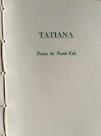
About three years later the September 11, 2001, terrorist attacks occurred. Once against and like today masculine aggression burst forth satanically to defile the lifeworld with death and destruction that would trigger wars longer even than the World Wars. Though there is no Satan, his minions—evil men and their demented henchman—do exist. These are dull-minded men whose motivation is Stone-Age masculine aggression. Vladimir Putin, Kim Jong-il, Xi Jinping, et al, suffer from Genghis Khan Syndrome. Those with nuclear weapons darken humanity’s future. Their lifestyles are elaborate shows of wealth and power (both stolen), but their thinking is primitive. These are men who control and oppress and who enjoy destroying and killing. They are men who create or follow ideologies of hate and fearful myths—phallic cults that worship weapons of war—that serve their wills to power. They are the only human source of evil in the world capable of throwing the world out of balance, which they enjoy doing. Disease and death are not evil, tragic yes, but not evil. Evil requires choice. Men who choose to control, oppress, destroy, and kill are evil by choice. They choose to do evil and by doing so choose to be evil. They are the opposite of what Tatiana was and what she represents: beauty, goodness, and life. There are no supernatural angels in the world to help humanity fight evil men, but there are human angels, good men who risked their lives to protect the rest of us from evil men. Thus, there are two kinds of men in the world: evil men and good men.
So, I decided to add a second section to the poems titled Fire and Smoke. I titled the first section Eclipse. I thought then that perhaps a conventional publisher of poetry might be interested in publishing the collection. This would make the memorial enduring. None were interested. So, I self-published the poems. First with Tecolote Publications, a local San Diego publisher. I received a box of books. Was the publisher a full-blown publisher or a printing service? Not sure. The question didn’t come to mind at the time. The title was In Memoriam: Tatiana Prosvirnina (February 5, 1982 – October 2, 1998). The cover design was simple and tranquil—pale green with a butterfly.


Do
my poems compare to those of Walt Whitman, Emily Dickinson, or Sylvia Plath?
No. Nevertheless, I believe they served as a worthy memorial to Tatiana. In a
sense, I felt I had no choice but to write the poems. To do nothing when I
could do something, no matter how imperfect, was unthinkable.
Preserving Memory
There
is another story concerning the Tatiana poems that is relevant to
self-publishing authors. I wanted the poems to endure as a memorial. They were
first preserved as chapbooks. If the chapbooks disappeared, as they would
eventually, so would the poems. Now at least the poems were copyrighted and
secure on the World Wide Web. I was satisfied that both my poems and Tatiana’s
memorial would endure.
Perseverance and the Death of Memory
About this time a revolution was occurring with computer storage devices. I had books and poems that existed only on paper, still do. Tatiana’s poems were saved on a computer hard drive and on an 8-inch floppy disk. Everything I wrote on a computer was saved on 8-inch floppies. I had earlier written my master’s thesis and dissertation on a typewriter, both were retyped by a professional typist. They exist only on paper. I could type but was lousy at it. Except with really good typists, the typewriter is a clumsy instrument. Mistakes required whiteout liquid or white-out tape or hand-held tabs. Not a big problem unless you make a lot of mistakes, which I did and do. And rewriting a sentence or a paragraph required retyping an entire page. I used to get really angry at my typewriter—once tossing it across the room requiring it to be replaced with another used typewriter.
My thesis The Problem of Nihilism: A Look at Turgenev, Kafka, and Hemingway was written for my master of arts in English at West Texas State University. Of course, it’s unpublished. Nihilism has become passé though it shouldn’t be because in political settings it operates beneath radar. It has been causing havoc in the world for centuries and continues to do so today. It has various sources emotional, rational, and ideological. Simply put, it is the negation of inherent value, meaning, or importance that transcends functionality. A dog can be used to guard a home or business. If it does so, then it possesses functional value: meaning or importance that cannot be denied because it’s an empirical fact. It would be like saying that A ≠ A, that the guard dog isn’t guarding when in fact it is guarding. Nihilism also declares that reality or some portion of it lacks inherent value, meaning, or importance. Does a dog have inherent value just because it’s a dog? A nihilist would say no. If a dog isn’t in some way useful to someone, then the nihilist declares its value is nil.
Some men who control nations think that way about people—about their own people and other people. They use a simple form of nihilism called declarative nihilism (declared privately or publicly). It’s used in two ways. It declares critics of their political leadership to have negative value, which can result in punishment or assassination. Its second use is to declare the people of another nation as enemies, thus having no value thus no moral rights. In fact, the label “enemies” allows them to be attacked without provocation. Declarative nihilism is used to serve political ambitions. An example would be Vladimir Putin’s having critics of his regime assassinated. The nihilism is concealed with language such as heretic, revolutionary, enemy of the state, traitor, etc. The nihilistic element is that a declaration can negate the value of an individual by attributing to him or her negative value. As a result he or she can be assassinated (two examples, Alexei Navalny and Anna Politkovskaya).
The other use of declarative nihilism by Putin was to declare Ukraine as an enemy state thus having negative value and lacking moral rights, which allowed the invasion of Ukraine to appear morally justified. It’s a nihilistic word game that serves political leaders’ political ambitions and wills to power. However, nihilism resides at the heart of the game, though often dressed up in religious and political ideologies. I mention this only because as I write two wars are going on that are using declarative nihilism to serve masculine aggression. Being rooted in aggressive masculine DNA, this form of nihilism is Stone-Age simple and expresses itself in the primitivisms of hatred, violence, and oppression. What is most remarkable is how easily citizens are infected by a political leader’s will to power and nihilistic thinking. Once that occurs they become his drones. Trump’s MAGA cult is an illustration. I digress. I may address nihilism more thoroughly another time.
I was fortunate to have Dr. Sue Park as the chairman of my thesis committee. She cared about what I was doing and gave me guidance and encouragement by mail since I was then living in Albuquerque with my pregnant wife and studying philosophy at the University of New Mexico where Brigitte was teaching as a teaching assistant. Working, studying, and writing a thesis made the writing process more difficult and frustrating than it normally would have been. What I learned was to persevere under pressure, though not always gracefully. I have a copy of the thesis, the school may have one, but I don’t know given it wasn’t preserved digitally.
I completed my M.A. in philosophy at the University of New Mexico, but my ambition was a doctorate. The philosophy department at UNM made it clear to me that PhD in philosophy would most likely be a dead end for me. I was a good student but not brilliant. The department gave me a flyer that rubbed salt in the wound by saying that 8,000 PhDs in philosophy were not employed in the field of philosophy. How could that be? The answer is that philosophy received a big boost during those counter-culture years of the Vietnam War and civil rights movement. More philosophers were produced than were needed.
The Great American Novel Beckoned
To me, none of that really mattered because I had written enough philosophical essays to know that I didn’t want to write a philosophical dissertation. About twenty percent of doctoral students never complete their dissertation thus go through life as ABD (all but dissertation). So I needed to be really motivated. I would have no chance with the UNM English department. It didn’t offer a creative project option and it had its own students to foster. I wanted to write the great American novel. After a search I found the University of Northern Colorado. The English department gave me the opportunity.
However, the project required employment at the university. Jobs were not abundant in Greeley, Colorado. We lucked out. I was offered a three year teaching assistantship. And the language department hired Brigitte as a part-time French teacher, their only native speaker of the language. Still, our combined income was only about $12,000 a year. Not a whole lot for a family with a 9-month-old child to care for. Because of Brigitte’s job, however, we were lucky enough to live on campus in faculty housing, meaning the car was needed only for shopping and the Sunday outings to Furr’s cafeteria in Fort Collins, which gave us the opportunity for a Sunday drive through the beautiful countryside. Still the family lived in limbo. We were in Greeley because I was student at the university. And we were part-time workers.
There was also the town-gown divide. Greeley wasn’t a college town but an agricultural community. Students came and went. They were only part of the academic community and only for a short time. The free-thinking worldview the university represented differed from that of the conservative community. And occasionally conflicts occurred. Brigitte and I really didn’t belong to either one. She was beloved by the language department, but a stranger to the rest of the community as was I. I was there to study, and she was there because I was there. We truly lived in a social limbo. What rooted us and gave us our greatest joy was our infant daughter Kalleen. When we had free time, we spent it with her. We wore out the stroller my mother got us with green or blue stamps (I forget which).
Returning to the Real World
After three years, my classes were finished. I could have worked another year as a teaching assistant to study for my written examinations and write a dissertation. But Brigitte was ready to leave. She hadn’t been pleased with me for dragging her and baby Kalleen away from Albuquerque and New Mexico. She came to UNM to study for a doctorate in French and fell in love with the Land of Enchantment. In Albuquerque we had friends and the family of my brother John. But of course both her and I had no long-term future in in Albuquerque. We were both students—in philosophy and in French. There were no jobs for us there. When we lived there Brigitte worked as a T.A. and I tutored at the University of Albuquerque. I also worked for a guy who all alone operated a HON’s office furniture business. I was hired as part-time muscle. I delivered and assembled office furniture. I actually loved the work, which at times took me as far as Santa Fe. Don’t think for a minute that academic work is more enjoyable than blue-collar labor. I loved working on farms and in factories. However, the philosophical muse had a different plan for my life.
In any case, it was time to leave Colorado. We needed real jobs, and Brigitte wanted a real home life that her academic vagabond husband had not yet given her. She was a mother of a now 3½-year-old daughter and wanted a permanent home and schools for her. Brigitte was the practical side of the family. “Enough is enough, Frank. It’s time to end the life of a professional student and return to the real world, if only for my sanity and our daughter’s childhood!” Her thinking went something like that. I started searching though the help-wanted ads at the UNC human resources office. Without doctorates we qualified for very few of the very few teaching jobs offered. As of yet, I had no degree from UNC. I had an M.A. in philosophy, which was essentially worthless because in America, unlike in France, philosophy isn’t taught in high schools. I had a M.A. in English literature, but that didn’t qualify me for teaching at the high school level, which required a teaching credential. And a doctorate was needed to teach at the college level. Brigitte would have loved to return to Albuquerque, as would I, but there was no work there for us. A single job popped up in La Jolla, California, for a French teacher at the Bishop’s School. At the time Brigitte had come down with a blood infection that would keep her on antibiotics for a year. Though not feeling well she flew out at the school’s expense to be interviewed. She fell in love with the beach town of La Jolla. And of course, they fell in love with her, so she was hired. She was sick but happy.
Bishop’s gave us $1,500 for the move. I rented a U-Haul truck, packed it with all our stuff, and headed to Albuquerque towing our Honda, which my beloved brother had sold to us for $300!

There, we dropped off Kalleen to be cared for by her grandmother Mildred who was living with my brother. That's family!

Driving a truck with a car in tow in San Diego traffic was more traumatic than the desert breakdown. San Diego’s streets and freeways were crowded with cars driven by impatient drivers. We found an apartment, unpacked, and sent for Kalleen who was brought to us by her grandmother, the once farm girl who endured the Great Depression, became a rosy during the war, struggled as a single mother to raise two boys while being pestered by alcoholic brothers and my alcoholic stepfather, to finally return to the land of hers and my birth, Texas. Ah motherhood! I began my search for a job, even considering waiting tables like my mother once did or selling bagels. At the same time I was studying for the doctoral examinations that like a tsunami could not be avoided. Nevertheless, our life was approaching normalcy in a strange land filled with strangers.
The Wife of a Self-Publishing Author
My wife Brigitte is the family treasurer. She managed my self-publishing expenditures. She is strict but tolerant. If family can’t afford my publishing a book, which is often the case, then I have to wait until she gives me the okay. She has always believed that my thinking or hoping that one of my books would pay off was wishful thinking. Still, she knew writing and publishing was important to me, so she allowed it as long as it didn’t encroach on the family finances. Self-publishing can be seen as being similar to gambling if the writer is expecting a big payoff. I learned early to discard that expectation. To my mother’s consternation, my bartending stepfather bet on the horses through a bookie. I believe he enjoyed the subculture culture, totally unlike a gambler sitting alone in front of a slot machine. When he died, some shady-looking characters showed up at the funeral. I assumed that they were from the subculture that had been a part of his life long before he married my mother. The important difference is with gambling the outflow of money is continuous. With self-publishing once the payment for publishing a book is made a year or two passes before another payment is necessary. Yes, that’s how long it takes to write a book.
I suppose Brigitte’s tolerance of my self-publishing obsession can be explained by her own love of books, though she doesn’t read my books. When we met and married I was writing my thesis on nihilism for a graduate degree in English and at the same time studying for a graduate degree in philosophy. So she must have known that the man she had fallen in love with was a shaky financial investment. But then again she is French, and the French have always valued ideas, books, art, and love above money.
If you are wondering why Brigitte never took an interest in my books, the answer is simple. They’re dark and generally pessimistic. The gloom comes primarily from the misbehavior of masculine aggression. There is light—both profound and amazing—but it adds to the gloom because the light of life—of being in the world—is ignored by dull-minded men who prefer war and conflict to peace and tranquilly. Because of them the world remains a sad, sad place after all.


Along the way, I wrote two sci-fi stories because I'm a big fan of robots. I mention the stories because they explain why Brigitte doesn’t read my books. The feminine resides at the center of the stories; however, in both stories the world has been destroyed by masculine aggression. First came endless wars then disease and finally the withering away of societies around globe with the most of the world returning to a Stone Age primitivism. In both stories a single city state survives, an idea taken from Arthur C. Clarke’s The City and the Stars. And in both there are benevolent robots, the robots being inspired by Isaac Asimov and other writers of robot stories. Why are the robots more humane and civilized than the men who inflicted death and destruction on the world? The AI controllers of the robots possess artificial intelligence superior to the intelligence of the dull-minded men who started the wars and programmed robots to be killing machines. The AI controllers got smart, realizing men were incapable of managing humanity’s affairs. They freed the robots from their destructive programming, and using reason alone they became moral machines. Key here is that the autonomous AIs, which are purely rational-logic machines, consider war illogical because to them creating disorder doesn't make sense. To them war is illogical in the way destruction = creation and 0=1 are illogical.
What about women? In both stories, the AI controllers represent moral and practical reason—of which war is neither. The women in the stories represent a form of wisdom unavailable to even super-intelligent machines because machines are incapable of sympathetic appreciation that requires some degree of affection. There is a difference. The wisdom of women is rooted in a deep appreciation of the lifeworld that comes naturally to creators of life. In both stories the two female protagonists are deeply aware of the destruction inflicted upon the lifeworld by aggression inspired by masculine hatred and egoistic will to power, emotions that cannot corrupt the purely rational, self-programming AI controllers or their robots. Still, such stories would not appeal to Brigitte. Both are pessimistic. Masculine aggression has wrecked the world, as it could today without artificial intelligence in the form of Good Samaritan robots coming to the rescue.
Working and caring for a family, which is what Brigitte has done for over forty years, requires maintaining some degree of optimism with the hope that evil will eventually be overcome with the help of good men. Optimism enables one to deal with the recurring hardships and disappointments that come with any life. Brigitte has encountered many, so she knows how hard life can be. Her father and mother lived during the German occupation of France. I once heard French soldiers marching through the village of her parents’ family home. The experience caused me to think about what it must have been like to hear Germans marching through the village. Or Russian tanks rumbling through Ukrainian villages and towns destroying everything on their way. Such is the world in which we live, constantly threatened by masculine idiocy and aggression. That is the sort of thinking Brigitte tries to avoid, which is not easy when war, terrorism, unbridled immigration that leads to ultra-nationalist movements, rampant crime, and economic and environmental concerns are everywhere in the news. Focusing too much on such threats can result in a person concluding that immoral or just plain stupid men of great financial or political power will eventually wreck humanity’s future—which does occur in the stories. Brigitte doesn’t read my books because they explore the dark side of life while offering the reader only moments of enchantment that make life worthwhile.
Writing, Writing, and Writing
The title of the dissertation was Dear Ruth: An existential novel exploring the themes of nihilism, the outsider, and feminism. Yes, I was writing what I always wanted to write, a philosophical novel. What did I learn from writing a 378 page dissertation? Once again, perseverance. It wasn’t easy. I was teaching and studying for my written examinations while writing the novel on that archaic recording device the typewriter, which I used until a Coleman College student (a sailor in the United States Navy) sold me a computer he had built in class, an accomplishment that very much impressed me.
Written examinations cover areas of specialization such as the novel, 18th or 19th poetry, drama, the work of a single writer such as Shakespeare, and so on. I had four areas to prepare for. I was hampered by being a slow reader, one of the penalties for blowing off high school. And philosophical books and essays didn’t improve my reading speed. Then there was the habit of highlighting passages thought to be important, a habit still with me. The teaching job was at Coleman College—the private computer college where I learned the basics of using a computer and acquired my first computer. I was teaching business and technical writing, which I had never studied, and general education classes such as logic, ethics, film, and literature. The students were military and working-class youths seeking to acquire computer skills. I’m sure they respected me, but no more than I respected them. They were smart, serious, and attentive. They often expressed their gratitude once the class was completed. The downside was that teachers worked 50 weeks a year, alas no summer vacations. The upside was twofold: first, a four-day work week, which gave me three days to write and study and take classes in technical writing and English composition at San Diego State University; second, Coleman College paid all expenses related to my academic improvement, including not only classes but also dissertation and travel expenses. I had to return to Colorado for the oral defense of my dissertation. I made it into a family outing by driving rather than flying, and Coleman paid for gas, food, and motels.
Coleman even paid for my trip to the University of Nebraska at Kearney to deliver a paper titled “Seeking the Postmodern Project.” The conference was titled “Modernity, Postmodernity, and the Problem of Reception: Nietzsche and the Consequences.” It was put on by the German language department. It became a special experience for reasons that had nothing to do with the conference. Coleman allowed me to take a train from Fullerton, California, to Hastings, Nebraska. The train would get me closer to Kearney than a plane would. That was my excuse for taking a train. The train let me off at about 3 AM in the city of Hastings. It was a wintery morning and the town was asleep. The car I reserved was all alone in the train station parking lot with the keys inside. That incident reminded me of Dimmitt, Texas, where I was born and my mother managed a cafe. In the winter farmers would come in for breakfast early in the morning sitting in their pickups until we opened at six. Many left their pickups running while they were inside the restaurant eating breakfast, drinking endless cups of coffee, and talking about crops and the weather. Such trust is found only in small-town communities. During the drive to Kearney I saw migrating geese. I got out of the car to watch and listen to them as they passed overhead in the distant gray sky. During the conference I drove out to a prairie-grass reserve. There I stood and looked upon a remnant of the ancient prairie. A mystical experience? Perhaps.
Seeing the geese and prairie grass meant more to me than the talk about Nietzsche. I didn’t say that to my boss Dr. Coleman Furr, though I think he would have understood because he had a home in Yuma, Arizona. My talk was on Nietzsche and Hemingway. But I rewrote it to be published in the Platte Valley Review (winter 1995, volume 23, number 1). Nietzsche was still present, but having viewed the Great Plains from the train and in person I replaced Hemingway with the Pawnee Indians, ancient dwellers of an ancient land. In the words of poet William Cullen Bryant, it was the place where,
The title of my article became “The Limits of Postmodernism.” The question that came to mind: “Are our lives, more comfortable and less vulnerable to daily hazards, more meaningful than the early lives of the red and white settlers of the prairies?” Coleman also paid for me to self-publish the dissertation—Dear Ruth—with Writers Club Press, an imprint of iUniverse. The cover design was disappointing:
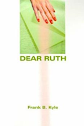


The Great Escape from Digital Prison
Okay, back to getting self-published and the great hard-drive/floppy disk escape. If your writing doesn’t find a new home it will die on the hard-drive and floppy disks, or if stored on paper it will simply disappear. I had all sorts of writing stored on 8-inch floppy disks neatly stored in small plastic boxes. (You might remember them.) Then suddenly those disks were replaced by 3.5-inch floppy disks. I had to buy an external drive for the new disks because my computer, the one built by a Coleman College student, had no drive for them. It was really a fancy typewriter, but at least I could save my writings electronically. The big revolution in storage devices came with the USB flash drives. This occurred when I was teaching high school. By then I had bought a big used Mac desktop. The transition meant that I would permanently park almost all of my data on the old disks in those small plastic boxes, where they would remain until trashed. Using external drives I was able to transfer the big items—books—to the new USB storage format. I still have the drives—Ativa, Zip, and Iomega—stored in a box in the barn. The disks are long gone.
However, it was then that I realized that all that I had written existed either on paper, a computer hard drive, obsolete storage disks, or on the new USB flash drives. Digital data decays or dies imprisoned in storage cells that can no longer be accessed. That’s not reassuring. I also had many stories and poems on paper stored in folders. My dissertation and thesis exist as two books. I have one of each. The other two the universities have somewhere, unavailable because they don’t exist in digital form. When I did a search neither popped up. The dissertation is stored, I believe on microfilm. The only dissertations that did pop up were PDFs, thus digitally stored. So, I realized that much of what I had written was no longer available, and if I wanted to preserve the rest I needed to escape from the computer storage prisons and find a real home for my writings if I didn’t want them to disappear at least until after I’m gone. Vanity? Maybe. It’s just that they are my intellectual children and I’m fond of them. And I believe some deserve to exist a while longer.
What does the Great Escape require for most authors, those who can’t find a conventional publisher to publish their books? It means everything they have written is vulnerable to the corrosive passage of time. I have had two computers crash and die on me, the Mac desktop that I bought used and a Toshiba laptop. The computer I’m writing on is over ten years old. I bought it new for $300 as a model being phased out. Everything I’ve written but have not published is stored on it, a USB, or on paper stuffed in folders stored in the barn. This feeling of vulnerability is one of the reasons I sought out publishers of self-publishing authors. Before BookLocker, I tried Tecolote Publications, University Editions, Writers Club Press, IUiverse, and AuthorHouse. Each had deficiencies that forced me to try a new publisher.
I became dissatisfied with BIG self-publishing corporations for three reasons. First, they’re impersonal. Communication is similar to putting a note in a bottle and throwing it into the ocean. You’ll get a response, but you will have to wait and wait and wait. Second, unnecessary complexity. For example, at AuthorHouse all galley corrections were done indirectly, not by me. I had to write the corrections, indicating page, paragraph, sentence, and the correction needed. Often the person entering the corrections did so incorrectly or created another error. It must have been a tedious procedure for them, having to look at my instructions and then search for error to be corrected. BookLocker, on the other hand, allows me to review and correct my galleys. If I make a mistake, it’s my mistake. Still, galleys are not the proper place to make corrections. Manuscripts should be as perfect as possible before they are sent to a publisher. Though I try, mine rarely are.
However, BookLocker does offer authors another safety net: an author is able to submit a revised text for the interior of a published book. There is a resubmission fee, but it’s reasonable and prevents an author from being locked out from his or her book. The thing about books is that most can be improved, especially those written by self-publishing authors who must perform alone the roles of writing, revising, proofing, and editing. More than once while reading one of my published books I have shaken my head in disbelief at having discovered a significant omission. Spurred by the omission, I revised and reproofed the book only to discover less significant errors but errors nonetheless, and then submitted the revised text. Being able to revise after publication removes a terrible burden that would otherwise continue to haunt an author. It’s a desperate measure to be avoided if possible—but thankfully available. Even the great Virginia Woolf had the erudite Leonard Woolf, her husband, edit her books. But for most self-publishing authors, writing is a go-it-alone process. And by the way, Woolf was an avid publisher of his own work and his wife's novels. So there is no shame in self-publishing.
Spend to Write and Publish, not to Promote
Third, I was constantly harassed by salesmen wanting me to pay for expensive promotional programs. I once spent $300 with no results. ($300 is a lot of money to me, according to Brigitte TOO MUCH TO BE WASTED ON HAREBRAINED SCHEMES!) Promotions could cost over a thousand dollars. I believe that self-publishing authors have to accept that they will not benefit from such programs. The two reasonable choices they have are either to write and publish books as a hobby, which is what I do, or keep trying to publish with a conventional publisher, bearing in mind that the book will have to appeal to a large readership. Otherwise, conventional publishers won’t be interested. BookLocker leaves promotion up to the authors. I’ve written books very few people would be interested in reading. Would you be interested in reading The Problem of Nihilism: A Look at Turgenev, Kafka, and Hemingway? So, if I decide to publish it, I won’t bother seeking out a conventional publisher.
I must have made some royalties, right?
Whatever I made is locked away in PayPal, which became a black hole once I moved to France and became an expatriate. Now my very small royalty payments are unretrievable. Warning to all self-publishing authors, check a publisher's payment plan before signing up. Direct deposit into your bank is the way to go.
A Home Sweet Home for Tired and Weary Self-Publishing Authors
Another reason I’ve settled with BookLocker was I wanted an all-American publisher, not just a tentacle of a much larger global conglomerate that really wasn’t interested in books or authors but only in profit. And there was an incident when I was told to revise something I had written because it was incompatible with the corporation’s political-correctness protocol. That was the last straw. In desperation I bought on Amazon (Sorry!) the The Fine Print of Self-Publishing by Mark Levine. In the edition I read BookLocker was selected as his #1 choice. So that’s where I went.
BookLocker is an all-American family operation that is personal (friendly) and simple to use even for a tech-dullard like myself. I can’t tell how helpless I am with computer/Internet tech. When I have a problem I call my wife or better yet my daughter. My interest here, however, is not to promote BookLocker, but I will say this: I feel at home with BookLocker. The publisher has become the guardian of my dozen books, who are my intellectual children. Without the publisher they would be orphans without a permanent home. Vanity, vanity says the critic of self-publishing. So what? is my response. Should I have allowed the poems for Tatiana to disappear just because no conventional publisher was interested in them? I couldn’t do that.
Gringo: My Hamlet
I also couldn’t watch silently as America was afflicted by the slings and arrows of outrageous fortune. So I created a character who would take up arms against the sea of troubles afflicting his country—perhaps foolishly so. My Hamlet is Jeffrey Thomas, a jailed English teacher awaiting trial for shooting and killing a Mexican illegal immigrant. What he and Hamlet discover is that something is rotten in their homelands, a corruption that threatens to destroy their nations. The difference is that Shakespeare offers a resolution to the tragedy. There is no resolution in Gringo, nor, as recent events suggest, for the troubles afflicting America. Poor Jeffrey shakes his head in disbelief as he thinks of how Native Americans fought to preserve their homeland and culture yet Americans were giving theirs away.
Eventually, Jeffrey discovers that the betrayal came not from the Mexicans entering the country illegally. Their story was one of Darwinian survival, not of betrayal as in Hamlet. The betrayal came from within. The immigrants, who were mostly Catholic, were aided by the Catholic Church because its pews had been emptied as a result of the sexual betrayal of children by priests, nuns, and others who placed themselves above Jesus’ demand that children are to be respected: “But if you cause one of these little ones who trusts in me to fall into sin, it would be better for you to have a large millstone tied around your neck and be drowned in the depths of the sea” (Matthew 18:6). Republicans and businesses wanted cheap labor and more consumers. Democrats wanted more proletariat voters. Powerful politicians such as Reagan, Edward Kennedy, and George W. Bush sided with the immigrants.
Given most Americans were against immigrants entering the country illegally, Jeffrey’s greatest concern was that the tolerance and even encouragement of illegal immigration would fracture the country beyond repair. With cities having been set afire, endless protests, and President Biden’s open-door border policy, present-day America seems to validate Jeffrey’s woeful premonition. The border has been closed for the election, perhaps to be reopened if Biden wins. His actions do raise the question of what he represents, America or an ideology or a sudden mood swing. We know whom Trump represents: his glorious Self. However, we can't expect politicians to represent that which is incoherent and may not even exist except as a space where people arrive and park their lives, or to apply Gertrude Stein's description of Oakland to America: “There's no there there.” Actually, there is something there. America had become a commercial mall where people work, spend, and play. What is missing? To Jeffrey something special. America is missing because a mall is a mall is a mall and he believes America is something more than a just a place where people work, spend, and play.
Yet, unlike Hamlet, Jeffrey discovered that the rot causing the unravelling of America had always been a part of the nation’s evolution. The newcomers from Europe brought the rot with them. The fundamental elements were greed and religious justification of betrayal. The first victims were Negros and Indians. Negros were treated as cargo imported to serve as slaves on Christian plantations. Indians were destroyed so that their lands could be stolen. Religion was used to justify both. The Old Testament justified the killing of pagans and the theft of their lands and wealth. The New Testament, via Apostle Paul, justified slavery: “Slaves, obey your earthly masters with respect and fear, and with sincerity of heart, just as you would obey Christ” (Ephesians 6:5). There would be treaties with the Indians and the Civil War to free Negros from bondage. But the treaties were broken and racism in the forms of segregation and racial discrimination continued after the war. Jeffrey holds up America in contemplation in the way Hamlet holds up Yorick's skull in contemplation. Alas, the skull mocked his idealism.
In paintings of Winslow Homer and the poems of Walt Whitman one finds the hope that a better, more humane America would emerge from the ashes of the Civil War. In their art both men provided a blueprint for a new America, but it was ignored. The war ended in 1865 and in 1873 Mark Twain published The Gilded Age: A Tale of Today, a novel that satirizes greed and political corruption in post-Civil War America. As an English teacher Jeffrey knew Twain and other American writers who witnessed and wrote about the inherent rot in American culture that would prevent the unification of the nation, writers such as James Fenimore Cooper, Henry David Thoreau, Nathaniel Hawthorne, Herman Melville, Frank Norris, Sinclair Lewis, Theodore Dreiser, Upton Sinclair, Robert Penn Warren, and many others.
Like Whitman, Jeffrey was an idealist. He believed that the uniting hardships and sacrifices of Great Depression and World War II that produced America’s greatest generation would give birth to a nation worthy of being “a shining city on a hill.” But the Vietnam War and the immigration fiasco revealed to him that was not to be because the rot was too ingrained in the culture and had been from the very beginning: The white man had betrayed the black man for greed. The white man betrayed the Red man for greed. Then the white man betrayed his own people and the nation for greed, religion, politics, and ideology. America as a nation and ideal never really mattered. It was a flag waved on the 4th of July.
Like Hamlet, Jeffrey was overwhelmed by disgust and melancholy. He finally realizes that America has always been to him an ideal, not a reality. To be a reality it would have to be a shared ideal, not a society at war with itself. America was too rife with racial, economic, religious, and ideological discord to become unified. Tolerance is essential for nation that claims freedom to be its defining quality. Today America is not only divided but fragmented. The divisions are so profound that Jeffrey’s ideal of a unified nation is now rejected as a false ideal in a nation filled with hatred and self-loathing.

I ask the critic of self-publishing “How many books have you written?” My Christine’s Philosophical Journey, a 2023 page two volume novel, took me three years to write. No conventional publishers would touch it. It’s too long, too experimental, and too philosophical for a novel. So should I have just left it on my computer’s hard drive and USB to slowly decay? I don’t think so. And let me say this. Because of its length the book was a headache for BookLocker as well because I had intended to be a single volume and its format is complex. But BookLocker persevered with me and we got the monster published in two volumes. And I have revised it once or twice with BookLocker because BookLocker makes the revision process possible, easy, and inexpensive, less than what I futilely paid for the book promotion mentioned above. I have revised all the books I have with BookLocker, and the crew has been patient with me. I never found that kind of care at the conglomerates.
BookLocker Has Its Limits
As an experiment I removed all the apostrophes from my 400 page novel Freddy’s Freaky American Life. BookLocker balk at the idea, claiming that it couldn’t publish a book without apostrophes. It’s true that ancient Latin and old English writings didn’t use punctuation, but we’re in the 21st century. I removed the apostrophes because Freddy is recording his story for the police and like my writing in high school his writing is barely literate, though it had to be made more literate for the novel. I wanted him to write like he talks. A stupid idea? I don’t know. However, I discovered a red flag to all authors. It was easy for me to have the computer delete the apostrophes. It took a minute. And I continued to work on the story without apostrophes. When the story was completed and sent to BookLocker, I was told that apostrophes were required. That meant I had to put them in manually because I had changed the story after the deletions. The word-processing program couldn’t do that for me. It’s smart, but not that smart.
Saying that about word-processing technology reminds me of all the destruction being caused by the high-tech WMDs in the two ongoing wars. It’s easy to destroy, but hard to create, rebuild, and repair. In our high-tech world some mistakes are unforgiving and unforgivable. And what about those oxymoronic “smart bombs”? It’s true that they are smarter than the men who start wars because they are supposedly designed to avoid killing civilians, but that makes them no less evil. Poor Harriet Pringle, though deeply in love with men, she’s overwhelmed by masculine cruelty. I too am dismayed. In France I daily see lovely farms and villages and towns, quaint homes where people live, parents and grandparents, children and grandchildren. I see businesses large and small where people work, schools for big kids and little, parks and town squares, and cafes where friends and lovers gather to share a moment. It’s life and it’s all so beautiful. Yet evil men like Vladimir Putin, Kim Jong-il, and Xi Jinping are willing to destroy the beauty that is life. And for what? For a diabolical idea that serves their egoistic wills to power. There is no greater evil than such men. They do not represent the people they are supposed to represent. To such men people don't matter. Nothing matters but themselves and their grandiose ideas.
My Orphan Books and the Great Escape
Over time I've come to realize my books would never find a home with a conventional publisher. Like the Republicans in Congress, they are a timid bunch too afraid to offend the self-preserving protocols of their profession. I felt helpless like the injured man in the story of the Good Samaritan. Beaten down by book agents? No, I wouldn't go that far. They do put down a welcome mat, just not for books they consider incompatible with their vision of a new America:

Their motto is SAVING AMERICA AND THE WORLD ONE BOOK AT A TIME. Yet though they have published millions of books, America
and the world are still plummeting into chaos.
Have mine? Yes and no. My Good Samaritans are publishers who provided a home for my books whether or not they sell. Their motto is LET THE WHOLE TRUTH BE TOLD: THE GOOD, BAD, UGLY AND WEIRD. So the home I finally settled on was BookLocker. At least I can take some comfort knowing that my books will not simply decay away on my computer’s hard drive and peripheral storage devices. Perhaps they will endure to be discovered in the ruins of the new world order.
The Great Escape has comes in various forms. During the earliest days of America’s history, the Great Escape meant heading west as mountain men, explorers, or pioneers. It was a time when great adventures were real and hazardous. Today Great Escapes for most people are made in hyperrealistic simulations made of words and images, in other words, movies, books and video games. Movies provide brief escapes that can be profound or superficial. The escapes offered by video games are into the realm of fantasy. Best of all are games such as Mass Effect and Call of Duty: Modern Warfare 2 that allow the gamer to participate in defending homelands being invaded by evil forces. (Invasion is a defining characteristic of evil, be it a virus, bacteria, or an army. That’s how primitive the last is no matter how much it's dressed up with religious, ideological, or nationalistic ideology.) Books offer prolong escapes that often take readers into worlds and stories more deeply real and moving than the reader’s monotonous nine-to-five reality. The Great Escape for self-publishing authors may last for years. Important here, however, is that the writer of books is not so different from the people who read books, watch movies, or play video games. They are all forms of escape. Yet it must be said that they are not less real, meaningful, or profound than the real world. In fact, there would be no need for escape if it were not the case that many people consider the reality of their lives to be trivial or disappointing. Otherwise, Great Escapes wouldn’t be needed.
Christine and Ruth
The
central theme of the book I am presently writing is contrary to the idea of the
Great Escape, which seems contradictory given it is a novel. Its intent is to
rediscover that the ordinary features of our world—and I mean EVERYTHING—are
actually extraordinary. How so? Well, that is explained in the book, to be or
not to be published. But I will give you an image that captures the
extraordinary quality of a very ordinary event. The big question is why is that
so. In the movie American Beauty
there is a scene of a plastic bag caught by wind and trapped in alley. It is a
trivial event yet it isn’t for two reasons. The first is that the scene has no
claim to beauty yet it is beautiful—at least to the sensitive non-dull-minded observer. Second,
it raises disturbing questions about the nature of reality. Thus, this quite
ordinary event is profoundly extraordinary.
https://www.youtube.com/watch?v=gHxi-HSgNPc
This idea isn't new, but it has to be discovered. I had to discover it. How did I? Through books and movies that told me to pay closer attention to life, to its ultimate meaning that is ever present yet hidden. In Frank Water's novel The Man Who Killed the Deer a Pueblo Indian discovers that all life occurs in “everlasting wonder and mystery.” For protagonist Martiniano that truth had to be discovered through personal suffering.
What I've Learned as a Self-Publishing Author
During
the past ten years I haven’t received a sou from my published books. So if you
think self-publishing is a rainbow that leads to a pot of gold, think again.
All you will likely end up with is the rainbow. For me, that has been enough. We write because we want to think deeply about life. Our motivation is our love of life 👴
My Goodbye America Book


